
Have you ever received a text that simply says “HBU?” and wondered what the person expects you to say? It’s a tiny abbreviation, but it can keep a conversation moving when you’re texting with friends, family, or someone you’ve just met online.
HBU means “How About You?” It’s usually used after someone has answered a question or shared something about themselves. Instead of typing the whole phrase, people use HBU to quickly ask the same thing back.
In this guide, you’ll learn the HBU meaning in text, how people use it in chats, where it came from, and what it means on social media and gaming platforms. You’ll also see natural examples of HBU in conversations and learn how to reply when someone sends it to you.
If you’ve seen HBU in Snapchat messages, Instagram DMs, texts, or online games, you’ll quickly see why this short phrase is so common.
HBU Meaning in Text
HBU means “How About You?”
It’s a casual abbreviation used to return a question to another person.
For example:
Person 1: I’m watching a movie right now. HBU?
Person 2: I’m just finishing my homework.
Here, HBU simply means “How about you?” The first person has shared what they’re doing and wants to know what the other person is doing.
HBU is mostly used in casual conversations. You might see it in text messages, Snapchat, Instagram, TikTok comments, Discord chats, gaming messages, or other social platforms.
It’s not complicated slang. In fact, it’s one of those abbreviations that people often understand immediately once they see it used in context.
Meaning at a Glance
| Term | Meaning | Tone | Common Platform |
|---|---|---|---|
| HBU | How About You? | Casual | Texting |
| HBU? | How about you? | Friendly | Social media |
| hbu | How about you? | Very casual | Chats |
| HBU! | How about you? | Friendly/energetic | Messages |
The capitalization doesn’t usually matter. HBU, hbu, and Hbu generally mean the same thing.
What Does HBU Stand For?
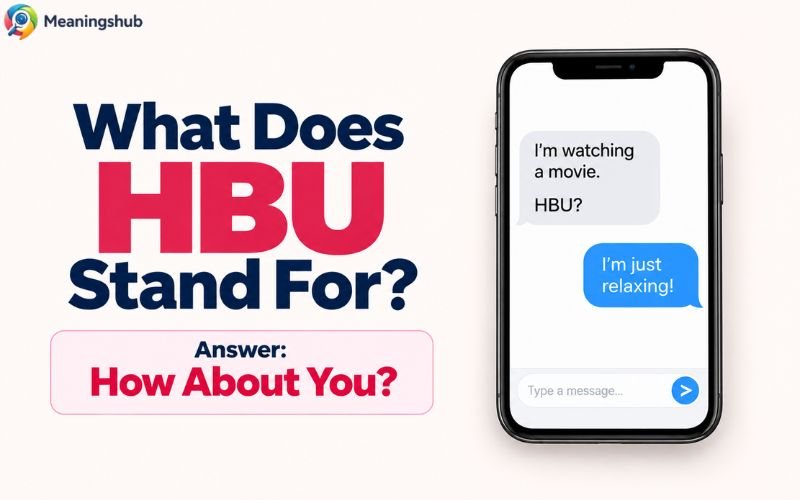
HBU stands for “How About You?”
People use it when they want to ask the other person the same question or get their opinion after sharing their own.
For example:
“I love pizza. HBU?”
This means:
“I love pizza. How about you?”
Another example:
“I’m going to the gym after work. HBU?”
That means:
“I’m going to the gym after work. How about you?”
The abbreviation saves time, especially during fast conversations. Nobody has to type the entire phrase.
You can think of HBU as a quick way of saying “And you?”
In many conversations, the two phrases can be used almost interchangeably.
How Is HBU Used in Texting?
HBU is especially common in texting because text conversations tend to be quick and informal.
Someone might tell you what they’re doing, how they feel, what they like, or what they plan to do. Then they add HBU? to keep the conversation going.
For example:
“I’m pretty tired today. HBU?”
The person isn’t asking for a detailed answer. They’re simply asking how you’re feeling.
Another example:
“I’m staying home tonight. HBU?”
You could reply:
“Same, I’m too tired to go out.”
This is one reason HBU works so well in casual conversations. It creates an easy back-and-forth.
Without HBU, a person might simply say:
“I’m staying home tonight.”
The conversation could end there.
Adding HBU? gives the other person something to respond to.
Related Post: WDYM Meaning in Text: What Does WDYM Mean?
HBU Meaning in Social Media
On social media, HBU has the same basic meaning: “How About You?”
You may see it in Instagram DMs, Snapchat conversations, Facebook Messenger, TikTok comments, or other casual online chats.
For example:
“I’m obsessed with this song rn. HBU?”
Here, the person wants to know whether you also like the song.
It can also appear after someone answers a personal question:
“I’m from Lahore. HBU?”
That simply means:
“I’m from Lahore. How about you?”
The abbreviation helps conversations feel quick and relaxed. It doesn’t usually carry any hidden meaning.
Sometimes people type hbu in lowercase because lowercase texting feels more casual.
HBU Meaning in Modern Slang
Although HBU isn’t exactly new slang, it remains common because it fits naturally into online conversation.
People often use short forms such as HBU, WBU, IDK, BTW, and TBH because typing an entire sentence isn’t always necessary.
HBU is more of a texting abbreviation than a slang word with a special definition.
Its meaning stays pretty consistent:
HBU = How About You?
The tone depends on the conversation. A friend might write:
“I’m good hbu?”
Someone you don’t know well might write:
“I’m studying computer science. HBU?”
The first feels very casual, while the second can still be polite even though it uses an abbreviation.
HBU in Gen Z Conversations
Gen Z and younger internet users often use abbreviations to make messages shorter and more natural.
HBU fits that style perfectly.
A conversation might look like this:
A: “I’m so bored rn.”
B: “Same 😭 hbu?”
A: “Nothing. Just scrolling.”
Here, HBU basically means “How about you?”
Emojis, lowercase letters, and abbreviations are often mixed together. That’s why you might see:
- hbu
- hbu?
- hbu lol
- hbu rn?
- hbu tho?
The extra words change the tone slightly, but HBU itself still means “How About You?”
HBU in Gaming Chats
Gamers also use HBU when chatting during games or in gaming communities.
For example:
“I usually play support. HBU?”
The player is asking what role the other person usually plays.
It can also be used outside the actual game:
“I’m playing Valorant tonight. HBU?”
“I’m taking a break from gaming. HBU?”
Since gaming chats can move quickly, short abbreviations are useful. HBU lets someone ask a simple question without slowing down the conversation.
You’ll commonly see it in Discord chats, game-related DMs, and casual messages between players.
How to Use HBU Correctly
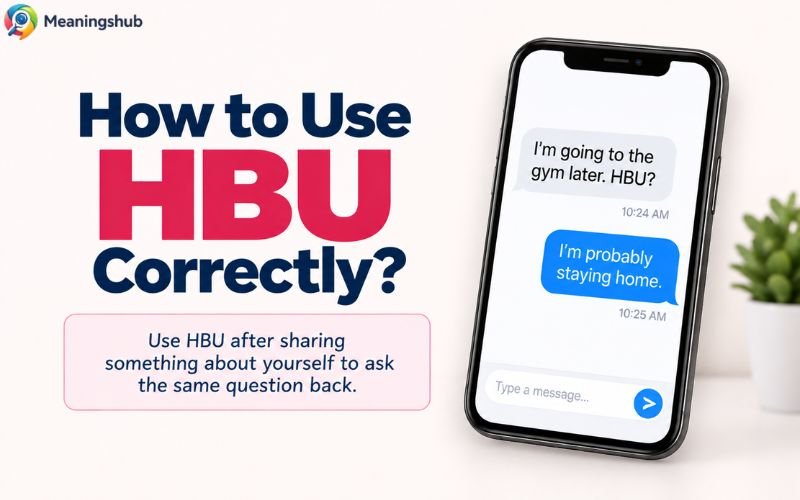
Using HBU is easy. Usually, you first answer or share something and then use HBU to ask the same thing back.
A simple pattern is:
Your answer + HBU?
For example:
“I’m 20. HBU?”
Or:
“I prefer cats. HBU?”
Or:
“I’m free this weekend. HBU?”
You can also use it after a longer message:
“I’ve been working all day, so I’m probably just going to relax tonight. HBU?”
There isn’t a strict grammar rule for HBU because it’s an informal abbreviation.
Still, adding a question mark is helpful because it makes the meaning clear.
Related Post: BTC Meaning in Text: What Does BTC Mean in a Text Message?
3 Real-Life Examples of HBU
Here are some everyday situations where HBU sounds natural.
Example 1: Asking About Plans
Alex: “I’m going out for dinner tonight. HBU?”
Sam: “I’m probably staying home.”
Alex is telling Sam about his plans and then asking what Sam plans to do.
Example 2: Talking About Interests
Alex: “I’m really into horror movies. HBU?”
Sam: “I like them too, but only the old ones.”
Here, HBU means “How about you?” and asks about Sam’s movie preference.
Example 3: Casual Texting
Alex: “I’m feeling much better today. HBU?”
Sam: “I’m doing good too.”
The abbreviation keeps the conversation short and natural.
HBU vs. WBU
You may have also seen WBU, which stands for “What About You?”
HBU and WBU are extremely similar.
For example:
“I’m watching Netflix. HBU?”
and:
“I’m watching Netflix. WBU?”
Both are asking what the other person is doing.
The difference is mainly the wording. HBU means “How About You?”, while WBU means “What About You?”
In everyday texting, either one can work in many of the same situations.
Related Slang Comparison
| Term | Meaning | When to Use |
|---|---|---|
| HBU | How About You? | Ask the same question back |
| WBU | What About You? | Ask about the other person |
| WYD | What You Doing? | Ask what someone is doing |
| IDK | I Don’t Know | Say you don’t know |
| TBH | To Be Honest | Give an honest opinion |
HBU vs. “And You?”
“And you?” is the more traditional way to ask the same question.
For example:
“I’m from Canada. And you?”
In texting, someone might write:
“I’m from Canada. HBU?”
Both mean almost exactly the same thing.
The main difference is tone. “And you?” can work in casual or more formal conversation, while HBU is strongly associated with informal online communication.
If you’re writing a professional email, HBU probably isn’t the right choice. Writing “And you?” or asking the question directly is safer.
Related Slang Terms You May See
HBU is part of a larger group of texting abbreviations. If you spend much time online, you’ll probably come across several of them.
WBU — What About You?
WBU is probably the closest abbreviation to HBU.
“I’m staying home tonight. WBU?”
It asks the other person what they’re doing or thinking.
WYD — What You Doing?
WYD is used to ask what someone is currently doing.
“Hey, wyd?”
It’s especially common in casual texting.
IDK — I Don’t Know
IDK is used when someone doesn’t know the answer or isn’t sure about something.
“What time does the movie start?”
“IDK.”
TBH — To Be Honest
TBH means “To Be Honest.”
People often use it before giving a straightforward opinion.
“TBH, I don’t really like that song.”
IMO — In My Opinion
IMO means “In My Opinion.”
It’s used when someone wants to make it clear that they’re sharing a personal view.
“IMO, the first movie was better.”
Example Sentences
| Situation | Example | Explanation |
|---|---|---|
| Plans | “I’m staying home. HBU?” | Asks about the other person’s plans |
| Food | “I love sushi. HBU?” | Asks about their food preference |
| School | “I’m studying tonight. HBU?” | Asks what they’re doing |
| Gaming | “I usually play support. HBU?” | Asks about their gaming choice |
| Feelings | “I’m doing okay. HBU?” | Asks how the other person feels |
Related Post: CM Meaning in Text: What Does CM Mean?
Can HBU Sound Flirty?
Sometimes, but HBU itself isn’t a flirty abbreviation.
The meaning doesn’t change just because two people are flirting.
For example:
“I’m single. HBU?”
The HBU still means “How About You?” However, the surrounding conversation may give it a romantic or flirty tone.
Another example could be:
“I’m free Saturday night. HBU? 👀”
The emoji and context might make the message feel suggestive.
So don’t assume HBU is automatically romantic. Look at the rest of the conversation.
Is HBU Rude?
No. HBU isn’t normally rude.
It’s a casual way to return a question. However, tone always depends on the conversation.
For example:
“Fine. HBU?”
could sound a little cold if someone expected a longer answer.
On the other hand:
“I’m doing great! HBU? 😊”
sounds friendly.
The abbreviation itself isn’t rude. The surrounding words, punctuation, and context can affect how a message feels.
Can You Use HBU With Strangers?
Yes, but it depends on the situation.
HBU is fine in casual online conversations with people you don’t know well. For example:
“I’m from Karachi. HBU?”
That’s completely normal in a casual chat.
However, you probably shouldn’t use HBU when talking to a customer, professor, employer, or someone in a formal business setting.
For formal communication, write the complete question instead.
Is HBU Still Used?
Yes, HBU is still used in casual texting and online conversations.
You may not see it in every message, but it remains easy to understand and useful.
Some people prefer WBU, while others simply type “and you?” The choice often depends on personal texting habits.
There’s also no need to capitalize it. You might see:
HBU?
or:
hbu?
Both mean the same thing.
Related Post: IMO Meaning in Text: What Does IMO Mean?
Frequently Asked Questions
What does HBU mean in text?
HBU means “How About You?” It’s a casual texting abbreviation used to ask another person the same question or get their opinion after you’ve shared your own.
What does HBU mean on Snapchat?
On Snapchat, HBU usually means “How About You?” Someone might send it after telling you what they’re doing, where they’re from, or how they feel.
For example:
“I’m bored rn. HBU?”
They’re asking what you’re doing or how you’re feeling.
How do you reply to HBU?
The easiest way is to answer the question that came before HBU.
For example:
“I’m watching a movie. HBU?”
You could reply:
“I’m studying.”
Or:
“Same, I’m watching one too.”
Just answer what they’re asking about.
Is HBU formal or casual?
HBU is casual. It’s best for texting, social media, gaming chats, and conversations with friends.
Avoid using HBU in formal emails, job applications, school assignments, or professional messages.
Is HBU the same as WBU?
They’re very similar. HBU means “How About You?”, while WBU means “What About You?”
Both are commonly used to ask the other person the same question.
Does HBU have any other meanings?
In normal texting, HBU most commonly means “How About You?” Context can matter, especially in specialized communities, but casual conversations almost always use it in this way.
Quick Recap
So, what does HBU mean in text?
HBU = “How About You?”
It’s a short, casual way to return a question to someone. You might see it in text messages, Snapchat, Instagram DMs, Discord, gaming chats, and other online conversations.
For example:
“I’m going to the gym later. HBU?”
Simply means:
“I’m going to the gym later. How about you?”
It’s not complicated slang, and there’s usually no hidden meaning behind it. If someone sends you HBU, just answer the question they’re returning to you.
And if you see WBU, don’t worry — it works in almost the same way. Both are just quick ways to keep a conversation going.
