
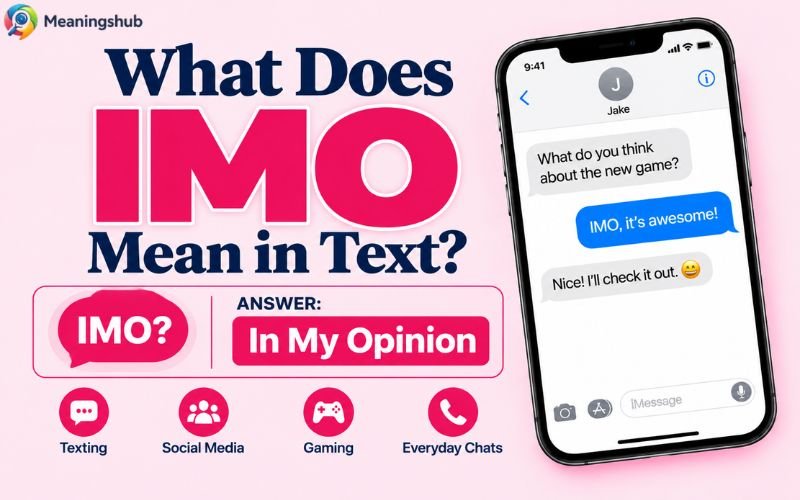
Have you ever received a text that says “IMO, that movie was better than the first one” and wondered what the three letters meant? If so, you’re not alone. IMO is one of the most common short forms used in texting, social media, chats, and online discussions. It usually means “In My Opinion.” People use it when they want to share a personal thought without making it sound like an absolute fact.
You’ll often see IMO before someone gives their view about a movie, song, game, food, relationship, or everyday situation. It can make a statement sound softer and more personal. For example, “IMO, this is the best pizza place” means “In my opinion, this is the best pizza place.” Below, you’ll learn the real IMO meaning in text, where the abbreviation came from, how people use it today, how it works on social media and in gaming, and how to respond when someone sends you “IMO.”
What Does IMO Mean in Text?
IMO means “In My Opinion.”
People use it before or after sharing a personal opinion. It tells the reader that the statement is based on the writer’s own thoughts or preferences.
For example:
“IMO, the blue one looks better.”
This simply means:
“In my opinion, the blue one looks better.”
The person isn’t saying that everyone has to agree. They’re making it clear that they’re sharing their own view.
IMO is especially useful in online conversations because written messages don’t always show tone clearly. Adding IMO can make a strong statement feel more personal and less like a command or fact.
IMO Meaning at a Glance
| Term | Meaning | Tone | Common Platforms |
|---|---|---|---|
| IMO | In My Opinion | Casual | Texting, social media |
| IMO | In my personal view | Friendly | Chats and DMs |
| IMO | This is what I think | Informal | Gaming and forums |
| IMO | Personal opinion | Neutral | Online discussions |
You don’t need to write IMO every time you share an opinion. It’s mainly useful when you want to clearly separate your personal view from a fact.
What Does IMO Stand For?
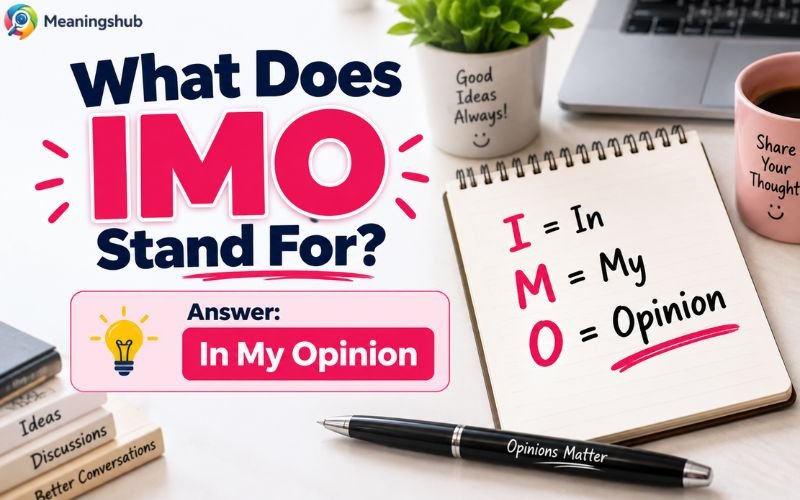
IMO stands for “In My Opinion.”
Each letter represents the first letter of a word:
- I = In
- M = My
- O = Opinion
It’s an initialism that became popular through online communication. People use it because typing three letters is faster than writing the entire phrase.
For example, instead of writing:
“In my opinion, this game is more fun.”
Someone can simply type:
“IMO, this game is more fun.”
Both sentences have the same basic meaning.
The shorter version just feels more natural in casual online conversations.
Related Post: What Does SNM Mean? Texting, Snapchat, Gaming, and Social Media
Where Did IMO Come From?
The phrase “in my opinion” is much older than the abbreviation itself. People have used it in regular speech and writing for a very long time.
The shortened form IMO became popular as online communication grew. Early internet chat rooms, message boards, forums, emails, and instant messaging encouraged users to write quickly. Abbreviations made long phrases easier to type.
IMO became part of the same online language as abbreviations such as LOL, BRB, BTW, IDK, and TBH.
Today, it doesn’t feel limited to old internet forums. You’ll find IMO in text messages, comments, group chats, gaming conversations, and social media posts.
One reason it has lasted is that the phrase remains useful. People constantly share opinions online, and IMO gives them a quick way to introduce those opinions.
How Is IMO Used in Modern Texting?
In texting, IMO is usually placed at the beginning of a sentence.
For example:
“IMO, you should buy the black shoes.”
It can also appear in the middle or at the end of a message:
“That was the best episode, IMO.”
The meaning doesn’t change.
People use IMO when discussing almost anything. It could be a serious topic or something completely ordinary.
“IMO, this restaurant is overpriced.”
“IMO, that hairstyle looks great on you.”
“The second game was more fun IMO.”
The abbreviation doesn’t automatically make an opinion correct or incorrect. It simply tells the reader, “This is my personal view.”
IMO Meaning on Snapchat and Social Media
On Snapchat, Instagram, TikTok, Facebook, X, Reddit, and similar platforms, IMO has the same basic meaning: “In My Opinion.”
You might see it in a comment when someone disagrees with a popular view.
For example:
“IMO, the original version is still better.”
The person is sharing their own preference. They’re not necessarily trying to convince everyone else.
Social media users also place IMO before strong statements to make them sound less absolute.
Compare these two messages:
“This is the worst movie ever.”
and:
“IMO, this is the worst movie ever.”
The second one clearly frames the statement as a personal opinion.
That’s one reason IMO is still useful in online conversations.
IMO Meaning in Gaming
Gamers use IMO when discussing characters, weapons, maps, strategies, updates, or games.
For example:
“IMO, the new map is better than the old one.”
Or:
“IMO, that character is easier for beginners.”
Gaming discussions often involve personal preferences, so IMO fits naturally.
Someone might also use it during a debate:
“IMO, you should save your special ability for the next round.”
That doesn’t mean the player has the only correct strategy. They’re simply giving their recommendation based on how they see the situation.
In gaming communities, IMO can also help keep a disagreement friendly. Instead of saying, “You’re wrong,” someone can say, “IMO, there’s a better way to do it.”
Related Post: ETA Meaning in Text: What Does “ETA” Mean?
How Gen Z Uses IMO
You can still see IMO among younger internet users, although slang habits vary from person to person.
Gen Z communication often mixes traditional internet abbreviations with newer expressions. IMO remains useful because it’s short, recognizable, and easy to type.
For example:
“IMO this song is underrated.”
Or:
“That outfit is actually cute IMO.”
You may also see it written in lowercase as imo.
There is no major difference between IMO and imo. The lowercase version simply has a more relaxed texting style.
People may also leave out punctuation:
“imo the first one was better”
That is common in casual chats and social media.
Is IMO Rude?
No. IMO isn’t rude by itself.
In fact, it can sometimes make a statement sound less forceful because you’re clearly presenting it as your own opinion.
For example:
“IMO, you could try a different color.”
This may sound softer than:
“You should use a different color.”
Still, tone depends on the rest of the message. If someone uses IMO before an insulting comment, the abbreviation doesn’t make the comment polite.
For example:
“IMO, your idea makes no sense.”
That’s still a fairly blunt statement.
So don’t judge the tone based on IMO alone. Read the complete message.
IMO vs. IMHO
One abbreviation that often gets confused with IMO is IMHO.
IMHO usually means “In My Humble Opinion.” Some people interpret the “H” as “Honest” instead of “Humble,” but “Humble” is the traditional expansion.
Both abbreviations introduce an opinion.
The main difference is that IMHO can sound slightly more playful or self-aware.
For example:
“IMO, the first movie was better.”
“IMHO, the first movie was much better.”
In everyday texting, people may use them almost interchangeably.
IMO vs. IMHO
| Abbreviation | Meaning | Typical Feel | Example |
|---|---|---|---|
| IMO | In My Opinion | Simple and direct | “IMO, it’s better.” |
| IMHO | In My Humble Opinion | Softer or playful | “IMHO, it’s better.” |
| TBH | To Be Honest | Honest or direct | “TBH, I didn’t like it.” |
| IME | In My Experience | Based on experience | “IME, it works well.” |
Real-Life Examples of IMO
Here are some natural examples of how people use IMO in everyday messages.
Example 1: Talking About Food
“IMO, this burger place is better than the one downtown.”
The person is saying that they personally think the burger place is better.
Example 2: Talking About a Movie
“IMO, the sequel was more entertaining.”
This means the speaker personally preferred the sequel.
Example 3: Giving Advice
“IMO, you should wait until tomorrow before replying.”
Here, IMO shows that the speaker is offering their personal suggestion rather than giving an official rule.
Example Sentences
| Situation | Example | Explanation |
|---|---|---|
| Movie | “IMO, the first movie was better.” | Personal preference |
| Food | “IMO, this is the best burger here.” | Personal judgment |
| Gaming | “IMO, this character is easier to use.” | Player’s view |
| Advice | “IMO, you should wait.” | Personal suggestion |
| Social media | “IMO, this trend is overrated.” | Personal opinion |
What Does IMO Mean at the End of a Sentence?
IMO doesn’t have to appear at the beginning.
Someone might write:
“The red one looks better, IMO.”
The meaning is still “In My Opinion.”
Putting IMO at the end can sometimes make the message feel more casual. It’s common in social media comments, forums, and quick chats.
For example:
“That was a terrible ending, IMO.”
The writer is simply adding a personal opinion after making the main statement.
You’ll also see:
“Best album this year IMO.”
This is a very casual way of saying, “In my opinion, this is the best album this year.”
Related Post: DW Meaning in Text: What Does “DW” Mean?
Can IMO Be Used in a Serious Conversation?
Yes. IMO can appear in both light and serious online discussions.
For example:
“IMO, the best solution would be to wait for more information.”
However, the abbreviation itself remains informal. If you’re writing a formal report, academic paper, legal document, or professional email, writing “in my opinion” is usually clearer and more appropriate.
A useful rule is simple: if you’d normally use texting language with the person, IMO is probably fine.
Is IMO Different From “I Think”?
Not really in basic meaning.
Both can introduce a personal belief.
“IMO, this is the best option.”
and:
“I think this is the best option.”
Both tell the reader that you’re giving your personal view.
The difference is mainly style. IMO is shorter and more common in casual online communication.
“I think” works almost everywhere, while IMO feels more like internet or texting language.
IMO vs. Other Opinion Slang
There are several abbreviations people use when sharing personal thoughts.
TBH means “To Be Honest.” It’s often used before a direct or personal statement.
IMHO means “In My Humble Opinion.” It’s another way to introduce an opinion.
IIRC means “If I Recall Correctly.” This is used when someone isn’t completely certain about a memory.
AFAIK means “As Far As I Know.” It shows that someone is sharing information based on what they know.
From my POV means “From My Point of View.” It focuses on someone’s perspective.
Related Slang Comparison
| Term | Meaning | When to Use |
|---|---|---|
| IMO | In My Opinion | Sharing your personal view |
| IMHO | In My Humble Opinion | Giving an opinion in a softer way |
| TBH | To Be Honest | Giving a frank thought |
| POV | Point of View | Showing a particular perspective |
| AFAIK | As Far As I Know | Sharing something with limited certainty |
How Should You Reply to IMO?
There’s no special reply required when someone uses IMO.
If you agree, you can say:
“Yeah, I agree.”
Or simply:
“Same.”
If you disagree, you can still keep things friendly:
“I see your point, but I actually prefer the second one.”
You can also ask why they feel that way:
“Really? What makes you think that?”
Remember, IMO is usually just an invitation to understand someone’s personal view. You don’t have to agree with it.
Is IMO Still Used?
Yes, IMO is still widely recognized and used in online conversations.
It has remained useful because people continue to share personal opinions through texts, comments, group chats, gaming communities, and social media.
That doesn’t mean everyone uses it. Some people prefer writing “I think,” “personally,” or “in my opinion.” Others may use newer slang instead.
Still, if you see IMO in a casual conversation, “In My Opinion” is the meaning you should usually consider first.
Can IMO Have Other Meanings?
Yes, abbreviations can have different meanings depending on the setting.
In casual texting and social media, IMO most commonly means “In My Opinion.” But outside slang, the same three letters can represent other terms, names, or organizations.
Context is the key.
If someone says:
“IMO, this song is amazing.”
the meaning is obvious: In My Opinion.
But if IMO appears in a technical document, business setting, or specialized conversation, it may have another meaning.
If you’re unsure, check the surrounding words instead of automatically assuming it means “In My Opinion.”
Is IMO Formal or Informal?
IMO is informal.
It’s perfectly normal in a text to a friend, a social media comment, a gaming chat, or a casual online discussion.
It’s generally better to avoid it in formal writing.
Instead of:
“IMO, this proposal needs more work.”
a professional message might say:
“In my opinion, this proposal needs more work.”
The longer version is clearer and fits a formal setting better.
Related Post: WBU Meaning in Text: What It Means and How to Use It
Frequently Asked Questions
What does IMO mean in text?
IMO means “In My Opinion.” It’s used when someone wants to share a personal thought, preference, belief, or judgment.
What does IMO mean on social media?
On social media, IMO usually means “In My Opinion.” People often use it before sharing their personal view about a trend, movie, song, post, game, or other topic.
Is IMO the same as “I think”?
The meaning is very similar. Both phrases can introduce a personal opinion. IMO is simply a shorter, more casual way to say “In My Opinion.”
What does lowercase “imo” mean?
Lowercase “imo” means exactly the same thing as uppercase “IMO.” The lowercase version is common in casual texting because people often don’t worry about capitalization.
How do I reply to someone who says IMO?
You can agree, disagree, ask a question, or simply continue the conversation. Responses such as “I agree,” “Same,” “I see your point,” or “Why do you think that?” can all work.
Is IMO formal or casual?
IMO is casual and informal. It’s suitable for texting, social media, gaming, and friendly chats. For formal writing, it’s better to spell out “in my opinion.”
Quick Recap
IMO means “In My Opinion.” It’s a short, casual abbreviation people use when sharing their personal thoughts or preferences.
You can find IMO in text messages, social media comments, gaming chats, group conversations, and online discussions. It can appear at the beginning or end of a sentence, such as “IMO, this one is better” or “This one is better, IMO.”
IMO is closely related to terms like IMHO, TBH, POV, and AFAIK, but each has its own meaning. If someone sends you “IMO,” they’re simply letting you know that what follows is their personal opinion, not necessarily an established fact.
