
English spelling rules can be confusing, especially when words change form by adding -ing. One of the most common grammar questions people search online is whether the correct spelling is glueing or gluing. Since both versions appear on websites, social media, and even in older publications, many writers are unsure which one they should use.
Whether you are a student, blogger, teacher, or professional writer, using the correct spelling helps make your work more accurate and trustworthy. The confusion mainly comes from English verbs that end with the letter e. Some of these words drop the final e before adding -ing, while others seem to follow different patterns.
Fortunately, the rule for this word is quite simple once you understand it. Learning the difference between glueing and gluing will help you avoid a common spelling mistake and improve your writing.
Glueing or Gluing: The Short Answer
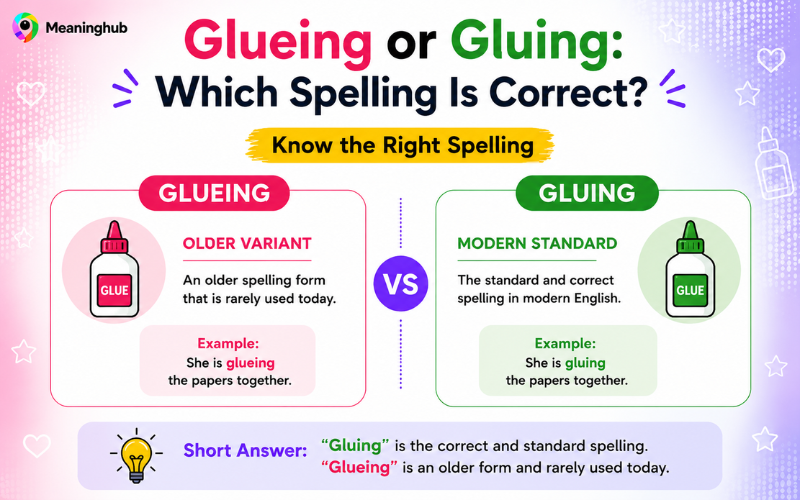
“Gluing” is the standard and correct spelling in modern English. “Glueing” is an older variant that is rarely used today.
What Does Gluing Mean?
The word gluing is the present participle and gerund form of the verb glue. It refers to the act of joining two or more objects together with an adhesive.
Examples:
- She is gluing the broken vase.
- The children are gluing pictures into their notebooks.
- Workers are gluing wooden panels together.
In modern dictionaries and style guides, gluing is considered the preferred spelling.
Is Glueing a Real Word?
Yes, glueing is a real word, but it is not the preferred modern spelling. It was used more often in the past because some writers wanted to preserve the pronunciation of the original word.
Today, however, most publishers, schools, and grammar experts recommend using gluing instead.
| Word | Status | Recommended |
|---|---|---|
| Gluing | Modern standard spelling | Yes |
| Glueing | Older variant spelling | Rarely |
Why Is There Confusion?
Many English verbs ending in e drop that final letter before adding -ing.
For example:
- Make → Making
- Write → Writing
- Bake → Baking
- Drive → Driving
- Glue → Gluing
Because the letter u comes before the dropped e, some people believe another e should remain, leading them to write glueing.
Although understandable, modern English generally accepts gluing.
The Grammar Rule
A simple grammar rule explains the spelling.
When most verbs end in a silent e, remove the e before adding -ing.
Examples:
| Base Word | -ing Form |
|---|---|
| Bake | Baking |
| Write | Writing |
| Drive | Driving |
| Smile | Smiling |
| Glue | Gluing |
This is why gluing is considered correct.
How Dictionaries Treat the Word
Major dictionaries list gluing as the standard form, while some also recognize glueing as a less common alternative.
Modern educational materials, style guides, and grammar checkers almost always suggest using gluing.
If you are writing for a blog, website, school assignment, or business document, gluing is the safest choice.
Examples of Correct Usage
Correct:
- I am gluing the pieces together.
- She enjoys gluing craft materials.
- They spent the afternoon gluing decorations.
- The carpenter is gluing the wooden frame.
Less Common:
- He is glueing the model airplane.
Although the second sentence is understandable, most editors would change it to gluing.
Related Post: Gases or Gasses: Which Spelling Is Correct?
Why Modern English Prefers Gluing
English spelling has evolved over time. Many older spellings have gradually disappeared because writers and publishers prefer simpler forms.
Words such as:
- Ageing → Aging (in American English)
- Routeing → Routing
- Singeing → Singeing (exception)
Similarly, gluing has become the accepted standard in most situations.
British English vs American English
One common question is whether British English prefers glueing.
The answer is generally no. Both British and American English commonly use gluing.
While older British publications may occasionally contain glueing, modern usage strongly favors gluing.
Gluing in Everyday Life
People use glue for many different purposes.
Common examples include:
- School projects
- Art and crafts
- Furniture repair
- Construction work
- Model building
- Packaging
In each case, the action is described as gluing.
Types of Glue Used for Gluing
| Type of Glue | Common Use |
|---|---|
| White Glue | School crafts |
| Wood Glue | Furniture |
| Super Glue | Quick repairs |
| Hot Glue | DIY projects |
| Epoxy Glue | Heavy-duty bonding |
Gluing in Arts and Crafts
Arts and crafts activities often involve gluing materials together.
Children may be:
- Gluing colored paper
- Gluing stickers
- Gluing fabric pieces
- Gluing decorations
Teachers and instruction books always use the spelling gluing.
Gluing in Construction
Construction workers use many adhesives.
Examples:
- Gluing floor tiles
- Gluing wall panels
- Gluing insulation materials
- Gluing decorative trims
Professional manuals almost always follow the modern spelling.
Common Mistakes Writers Make
Many people accidentally write:
- Glueing paper together
- Glueing wood pieces
- Glueing decorations
The preferred forms are:
- Gluing paper together
- Gluing wood pieces
- Gluing decorations
Using the modern spelling makes your writing look more polished.
Similar Spelling Questions
English contains many words that create the same kind of confusion.
Examples include:
- Ageing or Aging
- Judgement or Judgment
- Travelling or Traveling
- Cancelled or Canceled
- Dyeing or Dying
- Queueing or Queuing
Like these examples, gluing and glueing are often discussed because English spelling has evolved over time.
Why Correct Spelling Matters
Correct spelling helps:
- Improve readability
- Build trust with readers
- Make academic writing stronger
- Create professional content
- Avoid unnecessary corrections
Whether you are writing a school essay or publishing an online article, choosing the accepted spelling is always a good idea.
Easy Memory Trick
A simple way to remember the correct spelling is:
If the word ends with a silent e, drop the e and add ing.
Glue → Gluing
This small rule will help you avoid the mistake in most situations.
Glueing or Gluing in Online Searches
Many people search for:
- glueing or gluing
- is it glueing or gluing
- gluing meaning
- glueing meaning
- correct spelling of gluing
- how to spell gluing
The popularity of these searches shows that this grammar question is common among English learners.
When Should You Use Gluing?
Use gluing when:
- Writing blogs
- Completing school work
- Publishing articles
- Creating business documents
- Writing instructions
- Preparing academic papers
This spelling is widely accepted and recommended.
If you find this helpful then here is more for you:
- GL Meaning in Text: What It Really Means Online
- BBWS Meaning: Explained in Online Conversations
- HML Meaning in Text: Social Media Slang Explained
- HBY Meaning in Text: Simple Slang Everyone Uses Online
- What Does RCS Text Mean: Complete Guide
Frequently Asked Questions
Is it glueing or gluing?
The standard modern spelling is gluing.
Is glueing wrong?
Not completely. It is an older variant but is rarely preferred today.
Why is gluing spelled without the extra e?
Because English grammar usually drops the silent e before adding ing.
Do British and American English use different spellings?
Both generally prefer gluing.
Should students write glueing?
No. Students should use gluing in formal writing.
What is the gerund form of glue?
The gerund form is gluing.
Is gluing grammatically correct?
Yes. It is the accepted modern spelling.
Conclusion
The debate over glueing or gluing becomes simple once you understand the grammar rule. In modern English, gluing is the standard and recommended spelling because verbs ending in a silent e usually drop that letter before adding -ing. Although glueing is a recognized older variant, it is rarely used in current writing and may appear outdated. Whether you are working on a school assignment, writing a blog post, preparing professional documents, or creating online content, choosing gluing will help you follow modern grammar standards. By remembering the simple rule to drop the silent e, you can avoid confusion and write with greater confidence.
