
English is full of words that confuse even native speakers, and one of the most commonly searched grammar questions is whether the correct spelling is gases or gasses. Since both words exist in the English language, many students, writers, bloggers, and professionals struggle to know which one should be used.
The confusion becomes even greater because dictionaries list both spellings. However, they do not have the same meaning. One is primarily a plural noun, while the other is a verb. Understanding the difference will help you avoid common grammar mistakes and improve your writing.
Whether you are preparing a school assignment, writing an academic paper, creating blog content, or simply improving your English skills, learning the correct usage of these words is important.
Gases or Gasses: The Short Answer
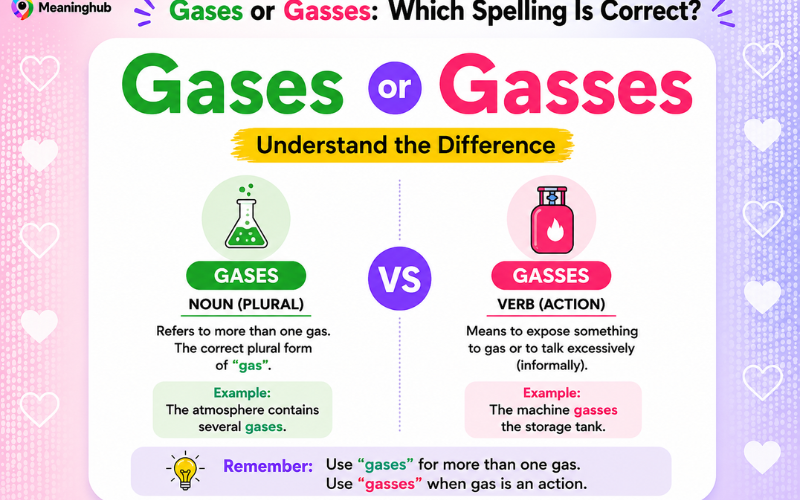
The correct plural form of the noun “gas” is “gases,” while “gasses” is usually used as a verb meaning to expose something to gas or, informally, to talk excessively.
What Is the Difference Between Gases and Gasses?
The easiest way to understand the difference is by looking at their grammatical functions.
| Word | Part of Speech | Meaning |
|---|---|---|
| Gases | Noun | More than one gas |
| Gasses | Verb | To expose to gas or to talk a lot |
In everyday English, you will almost always need the word gases.
What Does Gases Mean?
The word gases is the plural form of the noun gas. A gas is one of the four basic states of matter, alongside solids, liquids, and plasma.
Examples include:
- Oxygen
- Nitrogen
- Hydrogen
- Helium
- Carbon dioxide
When referring to more than one of these substances, the correct spelling is always gases.
Examples
- The atmosphere contains several gases.
- Scientists studied different gases in the laboratory.
- Greenhouse gases affect the Earth’s climate.
- Hospitals use medical gases for treatment.
What Does Gasses Mean?
The word gasses is usually the third-person singular form of the verb to gas.
It can mean:
- To expose something or someone to gas.
- To fill a system with gas.
- Informally, to chat or joke around.
Examples
- The mechanic gasses the engine.
- The operator gasses the storage chamber.
- He gasses with his friends after work.
Although this spelling is correct, it is much less common than gases.
Why Do People Confuse Gases and Gasses?
English spelling rules are not always straightforward.
For example:
- Bus → Buses
- Class → Classes
- Kiss → Kisses
- Gas → Gases
However, when the word is used as a verb, the spelling changes:
- Gas → Gassed
- Gas → Gassing
- Gas → Gasses
Since both forms exist, writers often accidentally use the wrong one.
Related Post: GL Meaning in Text: What It Really Means Online
The Grammar Rule
A simple rule can help you remember the difference.
Use gases when:
- Talking about more than one gas.
- Writing scientific or academic content.
- Referring to atmospheric or industrial gases.
Use gasses when:
- Using gas as an action.
- Describing the process of exposing something to gas.
Common Examples
Correct
- Oxygen and nitrogen are gases.
- Dangerous gases escaped the factory.
- Greenhouse gases contribute to climate change.
- Several gases were tested in the experiment.
Correct Verb Usage
- The machine gasses the storage tank.
- The worker carefully gasses the equipment.
Incorrect
- The atmosphere contains many gasses.
Correct
- The atmosphere contains many gases.
Gases in Science
The word gases is extremely common in science.
Scientists study:
- Atmospheric gases
- Noble gases
- Industrial gases
- Toxic gases
- Medical gases
Textbooks and scientific journals always use the plural form gases.
Common Types of Gases
| Gas | Main Use |
|---|---|
| Oxygen | Breathing and medicine |
| Nitrogen | Industrial applications |
| Hydrogen | Fuel and research |
| Helium | Balloons and cooling |
| Carbon Dioxide | Photosynthesis and beverages |
Greenhouse Gases
One of the most searched scientific phrases is greenhouse gases.
These include:
- Carbon dioxide
- Methane
- Nitrous oxide
- Water vapor
- Ozone
These gases trap heat in the atmosphere and play a major role in climate systems.
Gases in Everyday Life
People use or encounter gases every day.
Examples include:
- Natural gas for cooking.
- Oxygen for breathing.
- Carbon dioxide in soft drinks.
- Helium in balloons.
- Fuel gases in vehicles.
Gases in Medicine
Hospitals and healthcare facilities depend on several gases.
Common medical gases include:
- Oxygen
- Medical air
- Nitrous oxide
- Carbon dioxide
Doctors and nurses use these gases during treatments and surgeries.
Gases in Industry
Many industries rely on gases for manufacturing and production.
Examples include:
- Welding
- Food packaging
- Metal production
- Chemical manufacturing
- Energy generation
Gasses as a Verb
The verb form is much less common but still correct.
Examples:
- The system automatically gasses the chamber.
- The technician gasses the equipment before testing.
In some informal dialects, gasses may also mean talking a lot or entertaining people.
American and British English
Both American and British English use the same spelling rules.
Plural noun:
- Gases ✔
Verb:
- Gasses ✔
There is no regional difference for these words.
Why Dictionaries Include Both Words
Many people think one spelling must be wrong because dictionaries show both.
The truth is that both are correct, but they perform different jobs.
| Word | Function |
|---|---|
| Gases | Plural noun |
| Gasses | Verb |
The mistake happens when one is used in place of the other.
Common Writing Mistakes
Many writers accidentally use:
- Toxic gasses
- Natural gasses
- Atmospheric gasses
The correct versions are:
- Toxic gases
- Natural gases
- Atmospheric gases
Academic Writing
Students should always remember that the plural noun is gases.
Correct examples:
- Different gases react differently.
- The experiment involved several gases.
- Noble gases are stable elements.
Using gasses as a plural noun is considered incorrect in formal writing.
Professional Writing
Technical reports, educational books, and business documents also use:
- Petroleum gases
- Industrial gases
- Medical gases
- Greenhouse gases
These are the accepted forms.
A Simple Memory Trick
A useful way to remember the difference is:
If you are talking about more than one gas, choose gases.
If gas is being used as an action, the verb may become gasses.
This trick solves most grammar problems.
Similar Confusing Words
English has many similar grammar challenges, including:
- Affect vs Effect
- Advice vs Advise
- Breath vs Breathe
- Practice vs Practise
- Principal vs Principle
- Lose vs Loose
- Stationary vs Stationery
Gases and gasses belong to this group of commonly confused words.
Why Correct Spelling Matters
Correct spelling helps:
- Improve readability
- Build trust with readers
- Strengthen academic writing
- Increase professionalism
- Avoid misunderstandings
Whether you are writing for school or publishing a blog, using the correct form makes your work more reliable.
Frequently Asked Questions
Is it gases or gasses?
The correct plural of gas is gases.
Is gasses a real word?
Yes. It is generally a verb.
Can I write greenhouse gasses?
No. The correct phrase is greenhouse gases.
What does gasses mean?
It usually means to expose something to gas or, informally, to chat a lot.
Which word should students use?
Students should almost always use gases because it is the correct plural noun.
Do American and British English use different spellings?
No. Both follow the same rule.
Why do people confuse these words?
Because both spellings exist and have different grammatical functions.
Conclusion
The confusion between gases or gasses is understandable because both words are valid English terms. However, they are not interchangeable. Gases is the correct plural form of the noun gas and should be used when referring to multiple gaseous substances in science, education, medicine, and everyday writing. Gasses, on the other hand, is usually a verb that means to expose something to gas or, in informal speech, to talk excessively. By remembering that plural nouns use gases and action verbs may use gasses, you can avoid common grammar mistakes and write with greater confidence and accuracy.
