
Have you ever been texting someone and suddenly seen “BTW” in the middle of a message? If you know what it means, you probably don’t even think twice about it. But if you’re new to texting slang, you may wonder, what does BTW mean and why do people use it so often?
BTW means “by the way.” People use it when they want to add another thought, share a small piece of information, or change the subject slightly without starting a completely new conversation. It’s common in text messages, social media comments, online chats, gaming, and everyday conversations.
The BTW meaning is simple, but the tone can change depending on how it’s used. Sometimes it adds useful information. Other times, it introduces something funny, random, or even a little awkward. In this guide, we’ll explain what BTW means, where it came from, how people use it today, what it means in texting and social media, and how you can use it naturally yourself.
What Does BTW Mean?
BTW stands for “By The Way.”
It’s an abbreviation people use when they want to add something to a conversation that isn’t necessarily the main topic.
For example:
“I finished the homework. BTW, did you call Sarah?”
The first sentence talks about homework. The second sentence introduces a different subject: Sarah.
You could write the full phrase “by the way,” but BTW is much quicker. That’s one reason it became so popular in texting and online conversations.
Another example is:
“Your package arrived. BTW, I left it by the door.”
Here, the speaker adds extra information that might be useful.
BTW doesn’t usually change the main meaning of a sentence. Instead, it works like a little bridge between one thought and another.
BTW Meaning at a Glance
| Term | Meaning | Tone | Common Platform |
|---|---|---|---|
| BTW | By the way | Casual | Texting, social media |
| BTW! | By the way! | Friendly/excited | Chats, comments |
| BTW, … | Adding another thought | Casual | Messages, posts |
| By the way | Full form of BTW | Neutral/casual | Everyday conversation |
| BTW? | Introducing a question | Casual | Texting, chat |
What Does “By the Way” Actually Mean?
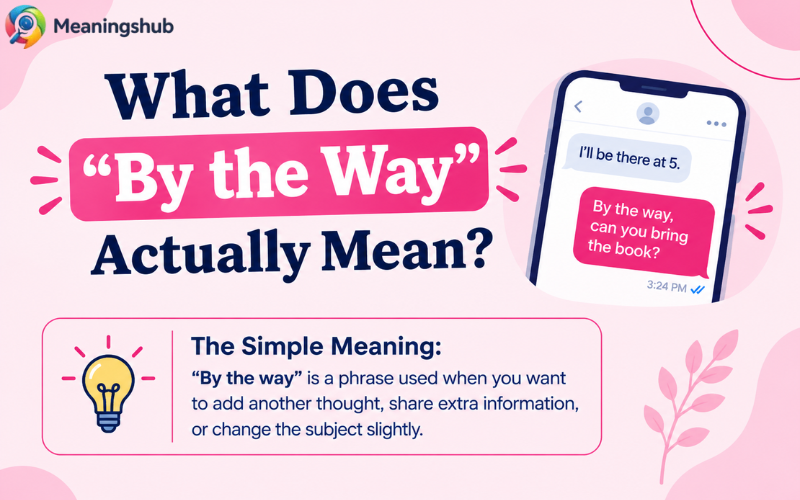
The phrase “by the way” is used when you want to mention something that is connected to the conversation but isn’t the main point.
Imagine you’re talking to a friend about going to the movies.
You might say:
“The movie starts at 8 PM. BTW, I already bought the tickets.”
The movie time is the main information. Buying the tickets is additional information.
You could also use BTW to suddenly remember something:
“BTW, don’t forget your jacket.”
Or to add a small personal comment:
“BTW, that was a really good restaurant.”
This makes BTW useful because it doesn’t require a major change in the conversation. You can simply add another thought and keep talking.
In my experience, it’s one of those abbreviations that feels completely natural in casual texting. Most people don’t stop to think about the letters anymore.
Related Post: What Does MK Mean in Text? Complete Guide(2026)
Where Did BTW Come From?
The full phrase “by the way” has been used in English for a very long time. The abbreviation BTW became popular much later as people began communicating through computers, internet forums, chat rooms, instant messaging, and text messages.
People wanted faster ways to type common expressions. Short forms such as LOL, BRB, IDK, and BTW became part of online communication.
As texting and social media became more common, BTW moved beyond early internet chat. It became normal in everyday digital conversations.
Today, you don’t need to be a heavy internet user to recognize it. You may see BTW in a message from a friend, a social media comment, or even a casual conversation between coworkers.
The abbreviation works because the full phrase is so familiar. Once you know that BTW means “by the way,” it’s easy to understand almost every common use.
How Is BTW Used in Modern Slang?
The BTW meaning hasn’t really changed. It still means “by the way.” What has changed is how casually and creatively people use it.
People may use BTW to:
- Add extra information
- Introduce a new topic
- Ask an unrelated question
- Remind someone about something
- Add a funny comment
- Bring up something they almost forgot
For example:
“I’m going to the gym after work. BTW, are you free tonight?”
The question about tonight isn’t directly related to the gym, but BTW makes the topic change feel natural.
Another example:
“I watched that new show yesterday. BTW, the ending is crazy.”
Here, BTW introduces an opinion about the show.
It can also be used sarcastically:
“BTW, thanks for telling me about the meeting.”
Depending on the context, this could be a genuine thank-you or a playful complaint because the person forgot to mention the meeting earlier.
That’s why tone and context matter.
BTW Meaning in Texting
Texting is probably the most common place you’ll see BTW.
People use it because texting often involves short, quick messages. Typing three letters is easier than typing “by the way” every time.
For example:
“BTW, what time are you coming?”
Or:
“BTW I need to borrow your charger.”
Or:
“I got home. BTW, your dog is sleeping on the couch.”
BTW can appear at the beginning, middle, or sometimes near the end of a message.
It doesn’t have strict grammar rules in casual texting. You may see:
BTW, are you coming?
Are you coming BTW?
BTW are you coming?
All three can be understood easily.
People also use lowercase:
btw
This is extremely common and usually doesn’t change the meaning.
BTW on Social Media
BTW is also common on platforms such as Instagram, TikTok, X, Facebook, Reddit, and Discord.
Someone might write:
“This outfit is from Zara btw.”
Here, “btw” adds a small piece of information at the end of the sentence.
Another common style is:
“BTW, who else watched the finale?”
This uses BTW to introduce a new question.
On social media, BTW can sometimes make a comment feel more casual. It can sound like the person is simply talking to friends rather than making a formal statement.
You’ll also see it in captions:
“New photo dump! BTW, this was taken last summer.”
The abbreviation fits naturally into social media because posts and comments often mix several ideas together.
Related Post: TD Meaning in Text: What It Really Means
BTW in Gaming and Online Chats
Gamers use BTW in much the same way as everyone else.
You might see it in a game chat, Discord server, gaming forum, or private message.
For example:
“BTW, the new update is live.”
Or:
“BTW, are we playing tonight?”
Or:
“I changed the server settings btw.”
Gaming conversations can move quickly, so short abbreviations are especially useful. Players may already be discussing a match, strategy, update, or teammate when they remember something else.
BTW lets them add that thought without making the conversation feel too formal.
It’s also common in Discord conversations because people often jump between topics quickly.
How Gen Z Uses BTW
Gen Z uses BTW much like older internet users do, but the abbreviation can sometimes be used for humor or emphasis.
For example:
“btw you’re actually hilarious”
Or:
“btw I was right 😂”
The lowercase style is common because casual texting doesn’t always follow traditional capitalization rules.
People may also place BTW at the end of a sentence:
“That movie was way better than I expected btw.”
In this style, BTW can almost feel like an afterthought.
It can also make a statement sound less serious:
“You forgot my birthday btw 😭”
The meaning is still “by the way,” but the surrounding words, emojis, and situation determine whether the message is playful, annoyed, or serious.
Common Ways to Use BTW
There are several everyday situations where BTW works naturally.
Adding Extra Information
“I’ll be home at six. BTW, dinner is already ready.”
The second part adds useful information.
Changing the Subject
“That game was fun. BTW, did you finish your project?”
The conversation moves from gaming to a project.
Giving a Reminder
“BTW, don’t forget to bring your ID.”
Here, BTW helps introduce a reminder.
Asking a Random Question
“BTW, what’s your favorite pizza topping?”
The question doesn’t need to be connected to the previous topic.
Adding an Afterthought
“Your presentation was great btw.”
The speaker adds the comment after making another point.
Related Post: What Does FT Mean: Meaning Usage, Context, and Examples
Real-Life Example Sentences
Here are a few natural examples that show how people actually use BTW.
“BTW, can you bring some snacks when you come over?”
The person is adding a small request to the conversation.
“I watched the movie last night. BTW, you were right about the ending.”
Here, BTW introduces an extra comment about the movie.
“I’ll send you the notes later btw.”
In this example, BTW appears at the end. It still means “by the way,” but it sounds more casual.
Example Sentences Table
| Situation | Example | Explanation |
|---|---|---|
| Extra information | “BTW, I already paid for it.” | Adds another detail. |
| Changing topics | “BTW, how’s your new job?” | Moves to a new subject. |
| Reminder | “BTW, bring your charger.” | Adds a reminder. |
| Casual comment | “That was funny btw.” | Adds an afterthought. |
| Question | “BTW, are you free tomorrow?” | Introduces another question. |
Is BTW Always Casual?
Almost always, BTW is casual.
It’s perfectly normal in text messages, social media posts, gaming chats, and conversations with friends.
However, you probably shouldn’t use BTW in a formal essay, official letter, academic assignment, or serious business document.
For example, this would look too casual in a formal email:
“BTW, I attached the report.”
A better choice would be:
“By the way, I attached the report.”
Even then, “by the way” may not be the best choice in a formal email. You could simply say:
“I’ve also attached the report.”
The important thing to remember is that BTW isn’t wrong. It’s just informal.
BTW vs. “By the Way”
There is no real difference in meaning between BTW and by the way.
BTW is simply the shortened version.
The main difference is tone.
“By the way” works in casual speech and writing.
“BTW” feels more like texting, social media, or online chat.
For example:
“By the way, I found your keys.”
and
“BTW, I found your keys.”
mean essentially the same thing.
The second version just feels shorter and more casual.
Related Slang Terms
BTW is only one of many abbreviations used in online conversations. Once you understand it, you’ll probably recognize several others.
IDK
IDK means “I don’t know.”
Example:
“IDK what time she’ll arrive.”
It’s common when someone doesn’t have an answer.
TBH
TBH means “to be honest.”
People often use it before giving a personal opinion.
“TBH, I didn’t really like the movie.”
It can also be placed at the end of a sentence:
“That was pretty good, TBH.”
FYI
FYI means “for your information.”
It’s used when you’re giving someone information they may find useful.
“FYI, the store closes at 9.”
It’s common in both casual and work conversations, although it can sometimes sound more formal than other slang abbreviations.
IMO
IMO means “in my opinion.”
It’s used when someone is sharing a personal view.
“IMO, the first game was better.”
LOL
LOL means “laughing out loud.”
People use it to show that something is funny or to make a message feel more playful.
“You really forgot your own password lol.”
Related Slang Comparison
| Term | Meaning | When to Use |
|---|---|---|
| BTW | By the way | Adding another thought |
| IDK | I don’t know | When you don’t know something |
| TBH | To be honest | Giving an honest opinion |
| FYI | For your information | Sharing useful information |
| IMO | In my opinion | Giving a personal view |
BTW, Btw, or btw: Which Is Correct?
All three forms are commonly understood:
BTW
Btw
btw
The choice mostly depends on personal style.
Using BTW in capital letters makes the abbreviation stand out more. Lowercase btw is very common in relaxed texting and social media.
For example:
“BTW, don’t forget the meeting.”
looks a little more noticeable.
Meanwhile:
“That was a good movie btw.”
looks more like a casual text.
Neither style changes the meaning.
Can You Say BTW Out Loud?
Yes, but people don’t usually pronounce the individual letters in everyday speech.
When speaking, most people simply say “by the way.”
For example, you wouldn’t normally say:
“B-T-W, did you see John?”
You’d simply say:
“By the way, did you see John?”
BTW is mainly a written abbreviation. It’s designed to save time and space when typing.
Of course, someone might jokingly say “B-T-W” out loud, especially when talking about internet slang, but that’s not the normal use.
How Should You Reply to BTW?
You don’t need a special response when someone uses BTW.
Simply respond to the information or question that follows it.
For example:
Friend: “BTW, are you coming tonight?”
You: “Yeah, I’ll be there around 8.”
Or:
Friend: “BTW, I left your book at my house.”
You: “No worries. I’ll get it tomorrow.”
Think of BTW as a conversation signal. It tells you that the person is adding another thought. You just answer that thought normally.
Can BTW Be Used in a Formal Message?
Technically, people may understand it, but it’s better to avoid it in formal writing.
If you’re writing to a teacher, employer, customer, or official organization, spelling out “by the way” or rewriting the sentence is usually a better choice.
For example, instead of:
“BTW, I attached the document.”
Try:
“I’ve also attached the document.”
That sounds cleaner and more professional.
BTW works best when the conversation is relaxed.
If You Find this Helpful, You Can Visit more.
FAQs About BTW Meaning
What does BTW mean in texting?
BTW means “by the way.” In texting, it’s used to add another thought, introduce a new subject, give a reminder, or share extra information.
What is the BTW meaning on social media?
The BTW meaning on social media is usually “by the way.” People use it in captions, comments, DMs, and posts when they want to add another detail or shift the conversation slightly.
Is BTW still used today?
Yes. BTW is still widely used in texting, social media, gaming chats, and online conversations. Lowercase “btw” is especially common in casual messages.
Is BTW formal or informal?
BTW is informal. It’s best suited to texting, social media, chats, and conversations with friends. In formal writing, use “by the way” or rewrite the sentence instead.
How do you reply when someone says BTW?
You simply respond to whatever information or question comes after BTW. There isn’t a special reply. For example, if someone says, “BTW, are you free tomorrow?” you can answer, “Yes, I am.”
Does BTW have any other meanings?
In everyday texting and slang, BTW almost always means “by the way.” However, abbreviations can have different meanings in specialized fields or specific communities. Context should always be considered when interpreting an abbreviation.
Quick Recap
So, what does BTW mean? It stands for “by the way.”
People use BTW when they want to add another thought, mention extra information, ask a side question, give a reminder, or slightly change the subject. It’s especially common in texting, social media, gaming chats, and other casual online conversations.
You may see BTW, Btw, or btw. They all mean the same thing.
For example, if someone texts:
“BTW, don’t forget your keys.”
They’re simply adding a reminder to the conversation.
The abbreviation is short, easy to understand, and still very common. If you’re comfortable with casual texting, you’ll probably see btw regularly. Just remember that it’s best kept out of formal writing where a more professional tone is expected.
