
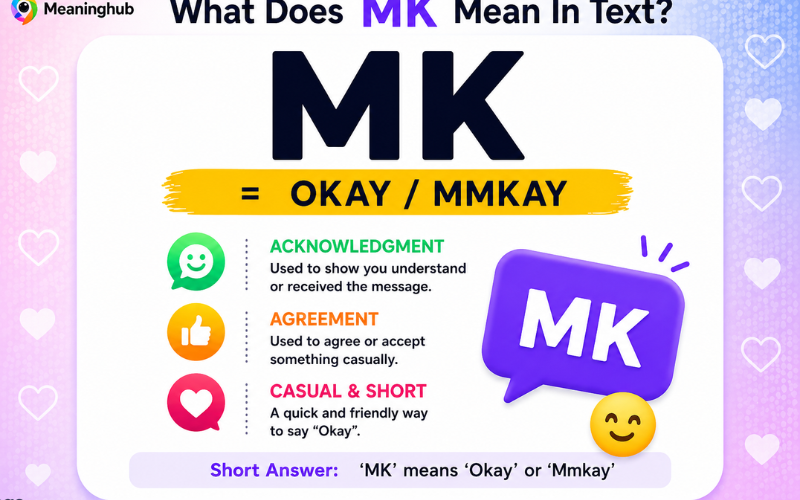
Text messaging is full of short abbreviations that make conversations faster and more casual. One acronym that often appears in chats, social media comments, and online conversations is MK. At first glance, it may seem confusing, especially if you are unfamiliar with texting slang.
In most cases, MK is simply a shortened version of “Mmkay” or “Okay.” People use it to acknowledge a message, agree with someone, or signal that they understand what was said. Depending on the tone and context, MK can sound friendly, neutral, hesitant, or even slightly sarcastic.
Because MK is short and versatile, it has become a common response in texting and internet communication.
MK Meaning in Text
MK most commonly means “Okay” or “Mmkay,” and is used to show acknowledgment, agreement, or understanding in a casual conversation.
What Does MK Mean in Text?
MK is a simplified form of:
- Mmkay
- Okay
- Alright
- Got it
It serves as a quick response when someone wants to confirm they understand or accept what was said.
Example:
- “Meet me at 7.”
- “MK.”
In this example, MK means “Okay, I understand.”
Quick Meaning Overview
| Abbreviation | Meaning | Common Use | Tone |
|---|---|---|---|
| MK | Okay | Acknowledgment | Neutral |
| MK | Mmkay | Casual agreement | Friendly |
| MK | Got it | Confirmation | Practical |
| MK | Alright | Acceptance | Relaxed |
Where Did MK Come From?
MK evolved from the spoken word “Mmkay”, which is an informal way of saying “Okay.” In speech, people often pronounce “okay” with a soft “mm” sound at the beginning, especially when they are thinking or responding casually.
Examples:
- “Mmkay, sounds good.”
- “Mmkay, I’ll do that.”
Over time, internet users shortened this spoken form to simply MK.
The Most Common Meaning of MK
In texting, MK usually means:
- Okay
- Sounds good
- Understood
- Fine
- Sure
It is often used as a quick reply that doesn’t require a full sentence.
Examples:
- “I’ll call you later.” → “MK.”
- “Please send the file.” → “MK.”
- “Dinner is at 8.” → “MK.”
Emotional Tone of MK
MK can carry different tones depending on context.
Neutral
A simple acknowledgment.
- “Bring the documents.” → “MK.”
Friendly
A relaxed response.
- “See you tomorrow!” → “MK 😊”
Reluctant
Shows mild hesitation.
- “You need to redo this.” → “MK…”
Sarcastic
Can imply annoyance.
- “Sure, whatever.” → “MK.”
Context and Meaning Comparison
| Context | Example | Meaning |
|---|---|---|
| Friendly chat | “MK, sounds good.” | Okay |
| Work chat | “MK, I’ll handle it.” | Understood |
| Argument | “MK…” | Fine, if you say so |
| Social media | “MK then.” | Acceptance |
Why People Use MK Instead of Okay
People use MK because it:
- Is faster to type
- Feels casual
- Mimics spoken language
- Can express subtle emotion
- Works as a quick acknowledgment
It’s especially useful when you want to keep the conversation moving.
MK in Text Messages
MK is commonly used in one-on-one conversations.
Examples:
- “Pick up some milk.” → “MK.”
- “Movie starts at 9.” → “MK.”
- “Don’t forget your keys.” → “MK.”
MK on Social Media
You may see MK in:
- Instagram comments
- TikTok replies
- X (Twitter) posts
- Facebook Messenger
- Snapchat
Examples:
- “MK then 😂”
- “MK, I see you.”
- “MK whatever.”
Related Post: TD Meaning in Text
MK in Relationships
Partners often use MK as a simple acknowledgment.
Examples:
- “I’m on my way.” → “MK.”
- “Let’s talk later.” → “MK.”
- “Don’t stay up too late.” → “MK ❤️”
Tone is important, as a short “MK” can sometimes feel distant.
MK Between Friends
Friends use MK casually and frequently.
Examples:
- “Game starts in 10.” → “MK.”
- “Send me the location.” → “MK.”
- “We’re leaving now.” → “MK.”
MK in Professional Communication
MK can appear in internal chats like Slack or WhatsApp, but it is usually better to use:
- Okay
- Understood
- Got it
- Will do
Using MK in formal emails may seem too casual.
MK vs OK vs K vs Mmkay
| Response | Meaning | Tone |
|---|---|---|
| OK | Standard acknowledgment | Neutral |
| K | Very brief; may seem cold | Curt |
| MK | Casual acknowledgment | Relaxed |
| Mmkay | Conversational agreement | Friendly |
MK often feels warmer than “K” and more informal than “OK.”
MK vs K
“K” can sometimes sound rude or dismissive.
“MK” tends to sound softer and more conversational.
Example:
- “See you later.” → “K.” (can seem cold)
- “See you later.” → “MK.” (friendlier)
MK vs Mhm
Both indicate acknowledgment, but:
- MK = Okay
- Mhm = Yes / I’m listening
Is MK Rude?
MK is usually not rude, but tone and context matter.
It may seem rude when:
- Used in an argument
- Sent without punctuation or emojis
- Given as a short response to a long message
It usually sounds normal in casual chats.
Is MK Passive-Aggressive?
Sometimes.
For example:
- “I guess I was wrong.”
- “MK.”
In this context, MK may sound dismissive or annoyed.
When MK Sounds Positive
MK sounds positive when:
- Used with emojis
- Sent in a friendly conversation
- Accompanied by additional text
Examples:
- “MK 😊”
- “MK, sounds good!”
- “MK, see you then.”
When MK Sounds Negative
MK may sound negative when:
- Used alone during conflict
- Followed by ellipses
- Responding to emotional messages
Examples:
- “MK…”
- “MK whatever.”
MK in Online Gaming
Gamers use MK as a quick acknowledgment.
Examples:
- “Push left.” → “MK.”
- “Meet in lobby.” → “MK.”
MK in Group Chats
In group chats, MK is a simple way to confirm plans.
Examples:
- “Dinner at 8.” → “MK.”
- “Bring snacks.” → “MK.”
Real-Life Text Examples
Example 1
A: Send me the notes.
B: MK.
Example 2
A: Let’s meet at noon.
B: MK, see you then.
Example 3
A: I think we should talk later.
B: MK.
Psychological Meaning of MK
MK often signals:
- Acceptance
- Understanding
- Mild agreement
- Emotional neutrality
The brevity can also indicate low emotional investment.
Benefits of Using MK
| Benefit | Explanation |
|---|---|
| Quick | Only two letters |
| Casual | Fits natural texting |
| Flexible | Can convey multiple tones |
| Friendly | Softer than “K” |
| Efficient | Keeps conversation moving |
Drawbacks of Using MK
| Drawback | Explanation |
|---|---|
| Ambiguous tone | May seem sarcastic |
| Too casual | Not ideal for formal communication |
| Short | Can feel dismissive |
Who Uses MK?
MK is commonly used by:
- Teenagers
- Adults
- Friends
- Couples
- Social media users
It is widely understood across age groups.
Common Variations of MK
People may use:
- Mk
- mK
- MKK
- Mmk
- Mmkay
The meaning remains essentially the same.
How to Respond to MK
Typical responses include:
- “Great!”
- “Thanks.”
- “See you then.”
- “Perfect.”
Often, no response is necessary.
Alternatives to MK
If you want to sound clearer:
- Okay
- Got it
- Sounds good
- Sure
- Understood
Misunderstandings Around MK
Some people may:
- Think MK sounds annoyed
- Misinterpret it as sarcasm
- Confuse it with other abbreviations
When in doubt, look at the overall tone of the conversation.
Is MK Still Popular?
Yes. MK remains a common shorthand in texting because it is simple, quick, and easy to understand.
MK in Pop Culture
The spoken form “Mmkay” became especially recognizable through television and internet culture, helping normalize its shortened text version.
Frequently Asked Questions (FAQs)
What does MK mean in text?
MK usually means “Okay” or “Mmkay.”
Is MK rude?
Not usually, but tone and context matter.
What does MK mean from a girl or guy?
It generally means “Okay” regardless of who sends it.
Is MK the same as OK?
Yes, but it feels more casual.
What does MK mean in an argument?
It may sound dismissive or passive-aggressive.
Can I use MK in professional messages?
It’s better to use “Okay” or “Understood.”
Is MK still commonly used?
Yes, it remains popular in texting and social media.
Conclusion
MK is a simple but versatile texting abbreviation that most commonly means “Okay” or “Mmkay.” It is used to acknowledge a message, show agreement, or confirm understanding in a casual and conversational way. While it is usually neutral or friendly, the tone can shift depending on the context, punctuation, and relationship between the people involved. Whether you see MK in a text message, social media comment, or group chat, it generally signals that the sender understands and accepts what was said. Understanding MK helps you interpret online conversations more accurately and communicate more naturally in everyday texting.
