
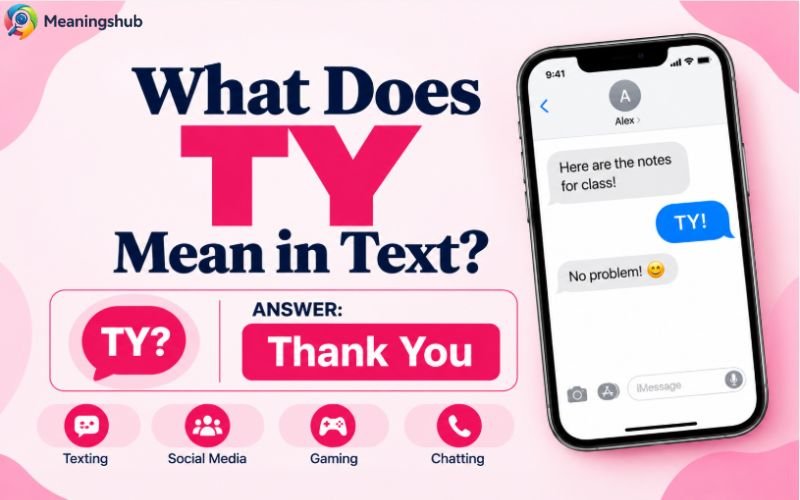
Have you ever received a quick message that simply says “TY” and wondered what the person meant? Don’t worry—this one is pretty simple. TY meaning in text is usually “thank you.” It’s a short and friendly way to show appreciation without typing the full phrase. You’ll often see it in text messages, Snapchat chats, Instagram comments, gaming conversations, and other online spaces.
Depending on the situation, “TY” can sound warm, casual, or simply quick and practical. For example, if someone sends you a useful link and you reply “TY!”, you’re simply saying thanks. You may also see versions like “ty,” “TYSM,” or “tyyy,” with the style changing slightly depending on the person and conversation.
In this article, I’ll explain what TY means, where it comes from, how people use it today, and how you can reply when someone sends it. I’ll also cover related slang terms and a few other meanings you may come across. By the end, you’ll have a clear idea of TY meaning and when it makes sense to use it.
TY Meaning in Text
The most common TY meaning in text is “thank you.”
People use it as a quick way to appreciate something another person has done, said, or shared. It can replace “thanks” or “thank you” in casual conversations.
For example:
“I sent you the notes.”
“TY!”
Here, “TY” simply means “Thank you!”
It’s one of those internet abbreviations that became popular because people often want to type less while chatting. Instead of writing two words and eight letters, they can type just two letters.
The tone usually depends on the conversation. “TY” by itself is neutral and casual, while “TYSM” (“thank you so much”) sounds more enthusiastic.
You might also see variations such as “ty!”, “TY 😊”, “tysm”, or “tyyy.” Adding an emoji or extra letters can make the message feel warmer.
Meaning at a Glance
| Term | Meaning | Tone | Common Platform |
|---|---|---|---|
| TY | Thank you | Casual | Text, chat, social media |
| TYSM | Thank you so much | Friendly | Text, Snapchat, Instagram |
| TYY | Thank you | Warm/playful | Text, social media |
| Thx | Thanks | Casual | Text, gaming, chat |
What Does TY Stand For?
TY stands for “thank you.”
It’s an abbreviation rather than a completely different slang word. The first letter comes from Thank and the second from You.
The idea is similar to other short forms used online. People often shorten common phrases so they can respond quickly.
You might see:
- “TY” = Thank you
- “TYSM” = Thank you so much
- “TYVM” = Thank you very much
- “Thx” = Thanks
- “YW” = You’re welcome
The meaning is usually easy to understand from context.
For example, if someone says:
“I saved you a seat.”
And you answer:
“TY!”
There isn’t much mystery. You’re thanking them.
One thing worth remembering is that TY isn’t normally used in formal writing. I wouldn’t use it in a job application, business letter, school essay, or professional email unless you’re having a very informal conversation with someone you already know well.
Related Post: What Does FYM Mean? Meaning, Slang, and Usage
Where Did TY Come From?
There isn’t one exact moment when “TY” was created. Like many internet abbreviations, it developed naturally from online communication.
Short forms became especially useful in early internet chat rooms, instant messaging, forums, and online games. People wanted to communicate quickly, and abbreviations made that easier.
“TY” is also closely connected with the growth of texting. Early mobile phones made typing slower than it is today, especially on phones with physical number keypads. Short expressions helped people send messages faster.
As online chatting became more common, abbreviations such as LOL, BRB, BTW, TY, OMG, and IDK became familiar to millions of users.
Today, you don’t need to be an old-school internet user to understand TY. Younger users see these abbreviations across messaging apps, games, social platforms, and online communities.
Interestingly, people still use “TY” even though modern smartphones make typing “thank you” very easy. At this point, it isn’t only about saving time. It has become part of casual online language.
How Is TY Used in Modern Slang?
Although TY meaning is simple, the way people use it can change slightly depending on the situation.
In Text Messages
Texting is probably the most common place you’ll see “TY.”
Someone might say:
“I grabbed your charger.”
You could answer:
“TY!”
It keeps the conversation moving without sounding overly formal.
You may also see it at the end of a longer message:
“Can you send me the address? TY!”
In this case, “TY” works almost like “thanks” at the end of a request.
On Snapchat and Instagram
People often use TY when replying to comments, messages, or compliments.
For example:
“Your outfit looks great!”
“TY 😊”
The abbreviation keeps the response short and relaxed.
On social media, you’ll also see combinations like TYSM, TY!, and tyyy. The extra letters or emojis can make the reply feel more expressive.
In Gaming
TY is very common in gaming chats.
Imagine a teammate gives you an item, helps you defeat an opponent, or revives your character. You might quickly type:
“ty”
Gamers often use short messages because they don’t want to stop playing just to type a full sentence.
You may see conversations such as:
“Here, take this shield.”
“ty”
Or:
“I’ll cover you.”
“ty!”
In fast-paced games, two letters can be much easier to type than “thank you.”
Among Gen Z Users
Gen Z uses TY, but that doesn’t mean every young person prefers it.
Online language changes quickly. Some people use “ty,” while others prefer “thx,” “thanks,” “tysm,” or simply an emoji.
The style can also depend on the person’s personality. “ty” may feel quick and relaxed, while “thank youuu” can feel more playful or excited.
Capitalization can change the vibe slightly too:
- TY — simple and clear
- ty — relaxed and casual
- ty! — friendly
- tyyy — playful or affectionate
- TYSM — more enthusiastic
There isn’t a strict rule for these differences. Context matters.
Related Post: What Does RD Mean? RD Meaning in Text, Slang, and Social Media
TY vs. TYSM vs. Thx
These terms all express thanks, but they aren’t exactly the same in tone.
TY is the basic short form of “thank you.”
TYSM means “thank you so much,” so it usually shows more excitement or appreciation.
Thx means “thanks” and is another short, casual option.
Here’s a quick comparison:
| Term | Full Meaning | Typical Feeling | Example |
|---|---|---|---|
| TY | Thank you | Neutral/casual | “TY for helping!” |
| TYSM | Thank you so much | More appreciative | “TYSM for the gift!” |
| Thx | Thanks | Very casual | “Thx for the info.” |
| TYVM | Thank you very much | Polite/emphatic | “TYVM for your help.” |
None of these are ideal for formal documents. They’re mainly used in casual digital conversations.
Real-Life Examples of TY
The easiest way to understand TY meaning in text is to see it in normal conversations.
Example 1: Asking for Help
Alex: “I uploaded the homework notes.”
Sam: “TY! I really needed those.”
Here, TY means “thank you.” Sam is showing appreciation for Alex sharing the notes.
Example 2: Social Media
Mia: “Your photo looks amazing!”
Lena: “TY 😊”
Lena is responding to the compliment. The emoji makes the short response feel warmer.
Example 3: Gaming
Player 1: “Dropped some health items for you.”
Player 2: “ty”
The player is thanking their teammate for helping them.
Example Sentences Table
| Situation | Example | Meaning |
|---|---|---|
| Friend helps you | “TY for picking me up!” | Thanks for helping |
| Social media compliment | “TY 😊” | Thank you |
| Gaming | “ty for the revive” | Thanks for reviving me |
| Someone sends information | “TY, that helps a lot.” | Thanks for the information |
How Do You Reply to TY?
If someone sends you “TY,” you don’t need a complicated response.
The most natural replies include:
- “YW” — You’re welcome
- “Np” — No problem
- “Anytime!”
- “Of course!”
- “No worries!”
- “Sure!”
The best response depends on what happened.
If someone says:
“TY for helping me.”
You could answer:
“Np!”
If a friend says:
“TYSM!”
You might respond:
“Anytime 😊”
For a casual chat, even a simple thumbs-up emoji can work.
Is TY Still Used?
Yes, TY is still used in online conversations.
You can find it in texting, gaming, social media comments, group chats, and other informal spaces. However, slang preferences aren’t the same for everyone.
Some people naturally type “ty,” while others prefer “thanks” because it feels more personal. Younger users may also use different variations depending on the platform and the people they’re talking to.
So, if you don’t see “TY” in every conversation, that doesn’t mean it’s outdated. It’s simply one of many ways people express thanks online.
I find that the shortest abbreviations often stay useful because they fit naturally into quick conversations. TY is a good example: two letters communicate the entire idea.
Is TY Formal or Informal?
TY is informal.
It’s suitable for casual situations where short, relaxed communication is expected.
Good places to use TY include:
- Text messages
- Gaming chats
- Snapchat
- Discord
- Casual group chats
- Online forums
It’s generally better to write “Thank you” in formal situations.
For example, instead of:
“TY for considering my application.”
A professional email would usually be better as:
“Thank you for considering my application.”
The full phrase sounds more polished and respectful.
Related Post: HMU Meaning in Text: What Does HMU Mean?
Related Slang Terms
If you’re learning internet slang, you’ll probably come across several terms related to TY.
1. TYSM
TYSM means “thank you so much.”
It’s more expressive than TY and is often used when someone wants to show stronger appreciation.
“TYSM for helping me!”
2. YW
YW means “you’re welcome.”
It’s commonly used as a response to TY.
“TY!”
“YW!”
3. NP
NP usually means “no problem.”
It’s another common response when someone thanks you.
“TY for sending that.”
“NP!”
4. THX
THX is a shortened form of “thanks.”
It’s very casual and has been used online for many years.
“THX for the update.”
5. TYVM
TYVM means “thank you very much.”
It sounds a little stronger than TY, although the tone still depends on context.
“TYVM for your help!”
Related Slang Comparison
| Term | Meaning | When to Use |
|---|---|---|
| TY | Thank you | Quick casual thanks |
| TYSM | Thank you so much | Stronger appreciation |
| YW | You’re welcome | Reply to thanks |
| NP | No problem | Casual response |
| THX | Thanks | Very casual thanks |
Can TY Have Other Meanings?
Most of the time, TY means “thank you” when you see it in a text or social media message.
However, abbreviations can have different meanings in specialized settings. A person’s industry, community, game, or conversation may give a short term another meaning.
For example, someone might use “TY” as part of a username, group name, technical abbreviation, or organization name. That doesn’t necessarily mean “thank you.”
This is why context matters.
If you’re chatting with a friend and they write:
“TY for the ride.”
It’s clearly “thank you.”
If you see “TY” inside a technical document, game-specific term, or organization name, don’t automatically assume it means the same thing.
Why Do People Use TY Instead of Thank You?
The biggest reason is convenience.
Typing “TY” takes only two letters. It’s quick, easy, and understood by most people who regularly use online messaging.
But convenience isn’t the only reason.
Sometimes TY feels more relaxed than “thank you.” A friend might write:
“TY!!”
rather than:
“Thank you very much.”
The second sentence can sound more serious depending on the context.
There’s also a social side to internet slang. People develop shared shortcuts that make online conversations feel natural. Once an abbreviation becomes familiar, using it doesn’t feel like cutting corners. It simply becomes part of everyday communication.
TY in Different Online Situations
The same abbreviation can fit many types of conversations.
| Platform/Situation | Example | Tone |
|---|---|---|
| Texting | “TY for the reminder!” | Casual |
| Gaming | “ty for the heal” | Quick |
| Snapchat | “TY 😊” | Friendly |
| “TYSM!” | Appreciative | |
| Discord | “ty guys” | Casual/group-friendly |
The basic meaning doesn’t change. What changes is the style around it.
A gamer may type “ty” because they’re busy playing. A friend on Snapchat might write “tyyy 🥹” to sound more emotional. Someone replying to an Instagram compliment might simply say “TY!”
When Should You Avoid Using TY?
There are situations where the full phrase “thank you” is a better choice.
Avoid TY in formal or professional writing such as:
- Job applications
- Cover letters
- Business proposals
- Official complaints
- Formal school assignments
- Professional correspondence
That doesn’t mean TY is wrong. It simply belongs to a more casual style of communication.
Think of it like “hey” versus “hello.” Both can be correct, but the situation determines which sounds more appropriate.
Related Post: What Does OTP Mean? Meaning, Uses, Examples, and Slang
Frequently Asked Questions
What does TY mean in text?
TY means “thank you” in most text messages and online conversations. It’s a casual abbreviation used to show appreciation quickly.
What does TY mean on Snapchat?
On Snapchat, TY usually means “thank you.” Someone might use it when responding to a compliment, receiving a photo, getting information, or thanking a friend for something.
How do I reply when someone says TY?
You can reply with “YW,” “NP,” “No problem,” “Anytime,” or “Of course.” In a very casual conversation, even an emoji can be enough.
Is TY rude?
No. TY isn’t normally rude. It’s simply short and casual. However, in some serious situations, writing the full “thank you” may feel warmer or more respectful.
Is TY still used?
Yes. People still use TY in texting, gaming, social media, group chats, and other informal online conversations. Some people prefer “thanks” or “tysm,” but TY remains easy to understand.
Can TY mean something besides thank you?
Yes, it can have other meanings in specific communities or contexts. However, in ordinary texting and social media conversations, “thank you” is by far the most common meaning.
Quick Recap
TY meaning in text is usually “thank you.” It’s a short, casual way to show appreciation and is common in text messages, gaming, Snapchat, Instagram, Discord, and other online conversations.
You can use TY when a friend helps you, someone sends you information, a teammate assists you in a game, or someone gives you a compliment. Related terms such as TYSM, YW, NP, THX, and TYVM are also common.
The main thing to remember is simple: TY is casual, while “thank you” is better for formal situations. If someone sends you “TY,” a quick “YW,” “NP,” or “Anytime!” is usually all you need.
