
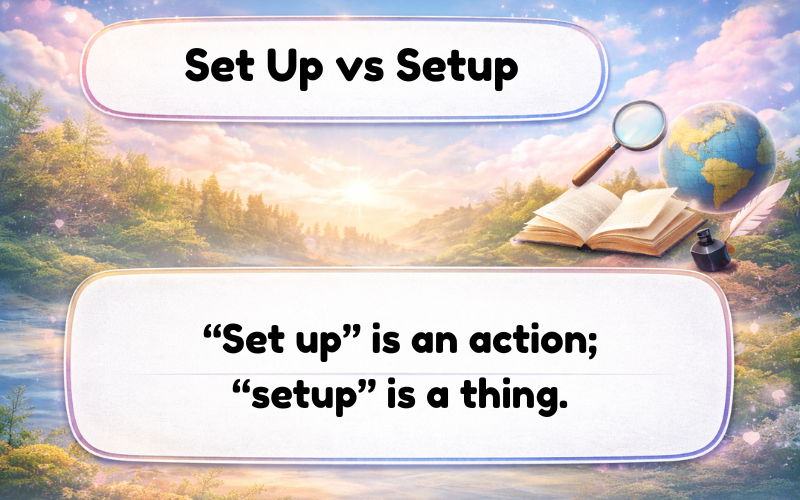
English learners and even native speakers often get confused between “set up” and “setup.” Although they look almost identical, these two forms have different grammatical roles and meanings. Using the wrong one can make writing appear unprofessional or grammatically incorrect, especially in academic, business, or online content.
This complete guide explains the difference between set up vs setup, including definitions, grammar rules, examples, common mistakes, usage tips, real-life contexts, and easy tricks to remember the difference forever.
By the end of this article, you will clearly understand when to use set up (two words) and when to use setup (one word).
Understanding the Core Difference
The easiest way to understand the distinction is this:
- Set up (two words) → Verb phrase (action)
- Setup (one word) → Noun (thing or arrangement)
Simple Rule
If you are describing an action, use set up.
If you are naming a thing or result, use setup.
What Does “Set Up” Mean?
Set up is a phrasal verb. It describes the act of arranging, preparing, organizing, or installing something.
Definition
To set something up means to prepare or arrange it so it is ready for use.
Examples of “Set Up” as a Verb
- I will set up the computer tonight.
- She helped set up the meeting.
- They are going to set up a new business.
- Please set up the equipment before the event starts.
In each sentence, someone is performing an action.
What Does “Setup” Mean?
Setup is a noun. It refers to the arrangement, system, structure, or configuration that results after something has been set up.
Related Post: What Does IDM Mean
Definition
Setup means the arrangement or way something is organized or prepared.
Examples of “Setup” as a Noun
- His gaming setup looks amazing.
- The office setup is very efficient.
- This camera setup is perfect for beginners.
- I like your desk setup.
Here, setup refers to a thing or configuration — not an action.
Side-by-Side Comparison
| Word | Part of Speech | Meaning | Example |
| Set up | Verb | Action of preparing | I will set up the room. |
| Setup | Noun | Arrangement/result | The setup looks great. |
Why People Confuse Set Up and Setup
There are several reasons for confusion:
- They sound identical when spoken.
- Many English words combine over time.
- Autocorrect sometimes changes spelling incorrectly.
- Informal writing ignores grammar distinctions.
Because pronunciation is the same, only grammar determines correctness.
Grammar Explanation in Detail
Set Up = Verb Phrase
A phrasal verb combines a base verb (“set”) with a particle (“up”).
It can change tense:
- Set up (present)
- Sets up (present singular)
- Setting up (continuous)
- Set up (past tense)
Example:
“She set up the system yesterday.”
Setup = Noun
As a noun, setup can function as:
- Subject
- Object
- Complement
Example:
“The setup took hours to complete.”
How to Identify Which One to Use
Ask yourself this question:
Am I describing an action or a thing?
- Action → set up
- Thing → setup
Quick Test
Try replacing the word with “arrange.”
If it works → use set up.
Example:
“I will arrange the meeting.”
“I will set up the meeting.” ✅
But:
“The arrange looks good.” ❌
“The setup looks good.” ✅
Examples in Everyday Situations
Technology
Correct:
- I need to set up my new phone.
- My phone setup is complete.
Business
Correct:
- They plan to set up a company.
- The business setup was expensive.
Events
Correct:
- Volunteers will set up chairs.
- The wedding setup was beautiful.
Set Up in Different Contexts
1. Installing Equipment
“Can you set up the printer?”
2. Organizing Events
“They set up the stage early.”
3. Starting Something New
“She wants to set up her own brand.”
4. Creating Accounts
“Set up your email account.”
Setup in Different Contexts
1. Workspace Arrangement
“My desk setup improves productivity.”
2. Gaming Environment
“This gaming setup costs $2,000.”
3. Technical Configuration
“The camera setup requires lighting equipment.”
4. Organizational Structure
“The company’s setup is unique.”
Common Mistakes People Make
Mistake 1: Using Setup as a Verb
Incorrect:
“I will setup the computer.”
Correct:
“I will set up the computer.”
Mistake 2: Using Set Up as a Noun
Incorrect:
“My desk set up looks great.”
Correct:
“My desk setup looks great.”
Memory Trick to Remember the Difference
Here’s an easy trick:
👉 If you can insert “to” before it, use “set up.”
Example:
“I want to set up the system.” ✅
You cannot say:
“I want to setup the system.” ❌
Set Up vs Setup in Professional Writing
Correct grammar is especially important in:
- Emails
- Reports
- Blogs
- Academic papers
- Business communication
Using the wrong form may reduce credibility.
Example:
Incorrect:
“Our IT team will handle the setup tomorrow.”
Correct (if action intended):
“Our IT team will set up the system tomorrow.”
British vs American English Usage
Both American and British English follow the same rule:
- Verb → set up
- Noun → setup
There is no regional difference in grammar here.
Related Word: Set-Up (Hyphenated Form)
Sometimes you may see set-up with a hyphen.
This form can act as a noun or adjective in certain styles, especially older or British usage.
Example:
“It was a clever set-up.”
However, modern writing usually prefers setup as one word.
Examples in Sentences (Practice Section)
Choose the correct form:
- Please ___ the meeting room.
Answer: set up - I like your computer ___.
Answer: setup - They will ___ the equipment tomorrow.
Answer: set up - The studio ___ looks professional.
Answer: setup
Why Correct Usage Matters Online
Clear grammar improves:
- Readability
- Professionalism
- Trustworthiness
- Communication clarity
Small differences like this can greatly affect how readers perceive your writing.
Set Up vs Setup in Digital Culture
Modern technology discussions frequently use both terms.
Examples:
- Streaming setup
- Office setup
- Home studio setup
- Set up software
- Set up Wi-Fi
Because technology requires both actions and configurations, confusion happens often.
Advanced Grammar Insight
English frequently converts verb phrases into nouns over time.
Examples:
| Verb Phrase | Noun Form |
| log in | login |
| sign up | signup |
| back up | backup |
| set up | setup |
This pattern explains why both forms exist.
Practice Paragraph Example
Correct usage together:
“I spent the morning trying to set up my workspace. After hours of adjustments, the final setup improved my productivity significantly.”
Notice how the first describes action and the second describes the result.
Frequently Asked Questions
Is “setup” ever a verb?
No. Standard grammar treats setup only as a noun.
Can “set up” be one word?
Not when used as a verb.
Which is more common online?
Both appear often, especially in technology and gaming discussions.
Does pronunciation change?
No — both are pronounced the same.
Quick Summary Rules
Remember these simple guidelines:
- Set up = action (verb)
- Setup = thing/result (noun)
- If someone is doing something → set up
- If describing an arrangement → setup
Real-Life Examples for Clarity
Correct Pairing
“I will set up my streaming equipment.”
“My streaming setup includes two monitors.”
Another Example
“They set up the office yesterday.”
“The office setup looks modern.”
Why This Difference Exists in English
English evolves through usage. Over time:
- Actions stay as phrases.
- Results become nouns.
This linguistic process explains many similar word pairs and helps maintain clarity between doing something and describing what exists afterward.
Final Thoughts
Understanding set up vs setup is simple once you know the grammatical rule behind it. Although they sound identical, their functions are completely different.
- Set up is a verb used when describing an action of arranging or preparing something.
- Setup is a noun referring to the arrangement, configuration, or result of that action.
Mastering this distinction improves writing accuracy, professionalism, and clarity across emails, academic work, business communication, and online content.
Whenever you feel unsure, remember the golden rule:
👉 Action = set up
👉 Thing = setup
With this knowledge, you can confidently use both forms correctly in any situation.
