
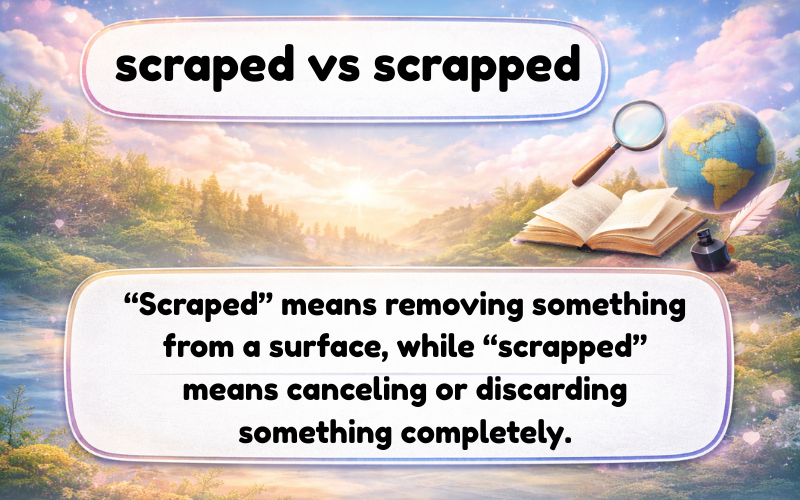
The English language contains many words that look and sound similar but have completely different meanings. One pair that often causes confusion is “scraped” and “scrapped.” Although they differ by only one letter, their meanings and uses are entirely different.
Many writers, students, and even professionals accidentally mix up these two terms in emails, articles, and everyday communication. Understanding the difference between scraped vs. scrapped is essential for clear and accurate writing.
This detailed guide explains the meanings, definitions, examples, grammar usage, and practical tips to help you remember when to use scraped and when to use scrapped.
What Does “Scraped” Mean?
The word scraped is the past tense of the verb scrape. It generally refers to removing something from a surface by rubbing or dragging a hard or sharp object across it.
In simple terms, scraping involves friction against a surface to remove material or move something along.
Definition of Scraped
Scraped means:
- To remove something by rubbing or dragging across a surface
- To injure or graze a surface lightly
- To collect or gather something with difficulty
This word is often used in physical actions involving surfaces.
Examples of Scraped in Sentences
Here are some examples that show how scraped is used correctly in everyday language.
Physical Surface Removal
- She scraped the mud off her shoes before entering the house.
- The chef scraped the burnt food from the pan.
- He scraped paint off the old wall during the renovation.
Minor Injury
- The child scraped his knee while playing in the park.
- I accidentally scraped my arm against the rough wall.
Gathering Something with Effort
Sometimes scraped is used figuratively.
- They scraped together enough money to buy a used car.
- The team scraped a win in the final minutes of the game.
In these cases, the word suggests difficulty or minimal success.
Related Post: DTF Meaning in Text
What Does “Scrapped” Mean?
The word scrapped is the past tense of the verb scrap. It means to cancel, discard, abandon, or throw something away because it is no longer useful or needed.
Unlike scraped, which involves physical removal from a surface, scrapped refers to eliminating or getting rid of something entirely.
Definition of Scrapped
Scrapped means:
- To cancel or abandon a plan or project
- To discard something as waste or junk
- To stop using something permanently
This word often appears in contexts related to plans, programs, vehicles, machines, or ideas.
Examples of Scrapped in Sentences
Canceling Plans
- The company scrapped the project due to high costs.
- The government scrapped the proposed law after public criticism.
- They scrapped their travel plans because of bad weather.
Throwing Something Away
- The old car was scrapped after the accident.
- The factory scrapped outdated machinery.
Ending an Idea or Strategy
- The marketing team scrapped the original campaign.
- The developer scrapped the design and started over.
In each example, scrapped means something was abandoned or discarded.
Scraped vs. Scrapped: The Key Difference
Although they look similar, the difference between scraped and scrapped is easy to understand when you focus on their core meanings.
| Word | Meaning | Example |
| Scraped | Removed by rubbing against a surface | She scraped the ice off the windshield |
| Scrapped | Discarded, canceled, or abandoned | The company scrapped the project |
Simple Way to Remember
- Scraped = Surface action
- Scrapped = Stopped or discarded
If the sentence involves removing something from a surface, the correct word is scraped.
If it involves canceling or throwing something away, the correct word is scrapped.
Why People Confuse Scraped and Scrapped
Several reasons explain why these two words are frequently mixed up.
Similar Spelling
Both words share almost identical spelling, differing only by one letter.
- scraped
- scrapped
Because they look so similar, people may accidentally type the wrong one.
Similar Pronunciation
In spoken English, the pronunciation of scraped and scrapped can sound very close, especially in fast conversations.
This makes it harder for learners to distinguish between them.
Autocorrect and Typing Errors
When typing quickly, writers sometimes miss the extra “p” in scrapped, which changes the meaning entirely.
Scraped in Different Contexts
The word scraped appears in many contexts beyond basic physical scraping.
Cooking
In cooking, scraping often refers to removing food from surfaces.
Examples:
- She scraped the batter from the bowl.
- He scraped the grill clean after cooking.
Construction and Renovation
Workers frequently use scraping tools to remove materials.
Examples:
- The painter scraped off old paint.
- The worker scraped rust from the metal surface.
Sports
In sports commentary, scraped sometimes refers to narrowly achieving something.
Example:
- The team scraped through to the next round.
Scrapped in Different Contexts
The word scrapped appears in many industries and discussions.
Business
Companies often scrap projects that are no longer profitable.
Example:
- The startup scrapped its expansion plans.
Technology
In software development, teams may scrap features or ideas.
Example:
- The developers scrapped the beta version after testing problems.
Government and Policy
Governments frequently scrap policies or regulations.
Example:
- The proposal was scrapped after debate in parliament.
Scraped vs Scrapped in Journalism
Journalists must use these words carefully because mixing them can change the meaning of a story.
Correct Example
- The government scrapped the program.
Incorrect Example
- The government scraped the program.
The incorrect sentence suggests removing something from a surface, which does not make sense in the context.
Tips to Remember the Difference
Here are some simple tricks to help you remember when to use each word.
Tip 1: Think of the Extra “P”
The extra P in scrapped can remind you of plans or projects being canceled.
Scrapped = Plan stopped
Tip 2: Think of Surfaces
If the sentence involves a surface or friction, use scraped.
Examples include:
- scraping ice
- scraping paint
- scraping food
Tip 3: Replace with “Canceled”
If you can replace the word with “canceled” or “abandoned,” then scrapped is correct.
Example:
- The plan was scrapped.
(Canceled)
Common Mistakes With Scraped and Scrapped
Here are some examples of typical mistakes.
Incorrect
- The company scraped the new product idea.
Correct
- The company scrapped the new product idea.
Incorrect
- She scrapped mud off her boots.
Correct
- She scraped mud off her boots.
Practice Examples
Try identifying the correct word.
Example 1
The old airplane was ______ after it became unsafe.
Answer: Scrapped
Example 2
He ______ the ice off the car windshield.
Answer: Scraped
Example 3
The team ______ their original strategy.
Answer: Scrapped
Example 4
She ______ gum from the bottom of her shoe.
Answer: Scraped
Related Words and Forms
Understanding related forms can also help clarify the difference.
Forms of Scrape
- scrape
- scraped
- scraping
- scraper
Example:
The chef used a scraper to clean the pan.
Forms of Scrap
- scrap
- scrapped
- scrapping
- scrap metal
Example:
The factory sells scrap metal for recycling.
Scraped vs Scrapped in Everyday Communication
Both words appear frequently in everyday conversations.
Everyday Example
- I scraped my car against the wall.
Work Example
- The company scrapped the entire marketing plan.
These sentences show how the two words function in completely different situations.
Why Correct Word Choice Matters
Using the wrong word can lead to confusion or misunderstanding.
For example:
- “The company scraped the project.”
This sounds strange because projects cannot be physically scraped. The correct word would be scrapped.
Accurate word choice improves clarity, professionalism, and credibility in writing.
Final Thoughts
Although scraped and scrapped look very similar, they have entirely different meanings. Scraped refers to removing something from a surface through friction or contact, while scrapped means abandoning, canceling, or discarding something completely.
Remembering this difference is important for clear communication, especially in writing where small spelling changes can significantly alter meaning.
By paying attention to the context and using simple memory tricks, you can easily choose the correct word every time.
