
English contains many words and phrases that sound similar but have very different meanings. These similarities can sometimes lead to confusion in writing and speaking. One common example is the pair “due to” and “do to.” Because they sound almost identical when spoken, many people mistakenly use them interchangeably.
However, “due to” and “do to” have completely different meanings and grammatical roles. One is a common phrase used to explain a reason, while the other is a combination of words used in specific contexts involving actions.
In this detailed guide, we will explore the meaning of due to, the meaning of do to, the differences between them, how to use each correctly, and practical examples to help you avoid mistakes.
What Does “Due To” Mean?
The phrase “due to” is commonly used to indicate the cause or reason for something. It is similar in meaning to phrases like “because of,” “caused by,” or “as a result of.”
Simple Definition
Due to means:
- Because of
- Caused by
- Resulting from
It is typically used to explain why something happened.
Examples of “Due To” in Sentences
Looking at examples helps clarify how this phrase works in everyday language.
Example 1
The flight was delayed due to bad weather.
This means the delay happened because of bad weather.
Example 2
The game was canceled due to heavy rain.
Here, rain was the cause of the cancellation.
Example 3
The meeting was postponed due to scheduling conflicts.
In this sentence, the conflicts caused the postponement.
In all these cases, “due to” introduces the reason behind an event.
The Grammar Behind “Due To”
Traditionally, grammar experts say “due to” should modify a noun rather than an entire clause.
For example:
Correct:
The cancellation was due to the storm.
Here, “due to the storm” describes the noun cancellation.
However, in modern English, many writers use “due to” more flexibly, often replacing “because of.” This usage is widely accepted in everyday writing.
Related Post: What Is BL
Common Situations Where “Due To” Is Used
The phrase “due to” appears in many types of communication.
Academic Writing
Students often use it when explaining causes or reasons.
Example:
The experiment failed due to incorrect measurements.
Business Communication
Professionals frequently use it in reports or emails.
Example:
The shipment was delayed due to transportation issues.
News and Media
Journalists commonly use “due to” to explain events.
Example:
The highway was closed due to an accident.
What Does “Do To” Mean?
The phrase “do to” is much less common and has a completely different meaning.
It is simply a combination of the verb “do” and the preposition “to.”
Simple Definition
Do to means:
- To perform an action toward someone or something
- To carry out an action affecting someone or something
Unlike “due to,” which explains a cause, “do to” refers to an action.
Examples of “Do To” in Sentences
Because this phrase involves an action, it usually appears in sentences describing something someone will do.
Example 1
What did you do to fix the computer?
Here, the sentence asks about the actions taken to fix something.
Example 2
What are you going to do to improve the project?
This question asks about actions planned for improvement.
Example 3
What did he do to upset you?
In this example, the phrase refers to an action that caused a reaction.
Key Differences Between Due To and Do To
Although the phrases sound the same when spoken, their meanings and grammar are very different.
| Phrase | Meaning | Example |
| Due to | Because of or caused by | The event was canceled due to rain |
| Do to | To perform an action toward something | What did you do to fix the problem? |
Simple Way to Remember
- Due to = reason or cause
- Do to = action performed
This simple distinction can help prevent confusion.
Why People Confuse “Due To” and “Do To”
There are several reasons why these phrases are commonly mixed up.
Similar Pronunciation
Both phrases sound almost identical in spoken English, making it easy to misunderstand which one is correct.
Spelling Confusion
Writers may accidentally type “do to” instead of “due to,” especially when typing quickly.
Lack of Grammar Awareness
Some people may not realize that “due to” is a phrase indicating cause, while “do to” refers to actions.
Examples Comparing the Two Phrases
Seeing the phrases side by side can help clarify the difference.
Example 1
Correct:
The delay happened due to heavy traffic.
Incorrect:
The delay happened do to heavy traffic.
Example 2
Correct:
What did you do to solve the problem?
Incorrect:
What did you due to solve the problem?
Example 3
Correct:
The match was canceled due to rain.
Incorrect:
The match was canceled do to rain.
Alternatives to “Due To”
Sometimes writers prefer using alternative phrases that clearly show cause.
Common alternatives include:
- Because of
- As a result of
- Owing to
- Caused by
- Thanks to
Example
Original:
The meeting was canceled due to illness.
Alternative:
The meeting was canceled because of illness.
Both sentences mean the same thing.
Tips to Remember the Difference
Learning simple memory tricks can help you use the correct phrase.
Tip 1: Look for the Cause
If you are explaining why something happened, use due to.
Example:
The delay happened due to weather conditions.
Tip 2: Look for an Action
If the sentence involves something someone did, use do to.
Example:
What did you do to fix the issue?
Tip 3: Replace with “Because Of”
If you can replace the phrase with “because of,” the correct phrase is due to.
Example:
The game was canceled due to rain.
The game was canceled because of rain.
Common Grammar Mistakes
Many grammar mistakes occur when writers incorrectly replace due to with do to.
Incorrect
The project failed do to poor planning.
Correct
The project failed due to poor planning.
Incorrect
The flight was delayed do to mechanical issues.
Correct
The flight was delayed due to mechanical issues.
Practice Sentences
Try choosing the correct phrase.
Example 1
The concert was canceled ______ bad weather.
Answer: due to
Example 2
What did you ______ improve your writing skills?
Answer: do to
Example 3
The school closed early ______ the storm.
Answer: due to
Example 4
What did she ______ make the recipe taste better?
Answer: do to
“Due To” in Formal Writing
In formal writing, some style guides recommend using “due to” carefully to ensure it modifies a noun properly.
Example:
The cancellation was due to the storm.
This structure is considered grammatically precise.
However, modern writing often allows more flexibility, especially in everyday communication.
“Do To” in Questions
The phrase “do to” most commonly appears in questions asking about actions.
Examples:
- What did you do to fix the car?
- What did they do to improve the system?
- What will you do to solve the problem?
These questions focus on actions taken by someone.
Why Correct Usage Matters
Using the correct phrase improves clarity and professionalism in writing.
For example:
Incorrect:
The project failed do to poor management.
Correct:
The project failed due to poor management.
The incorrect version may confuse readers or make the writer appear careless.
Final Thoughts
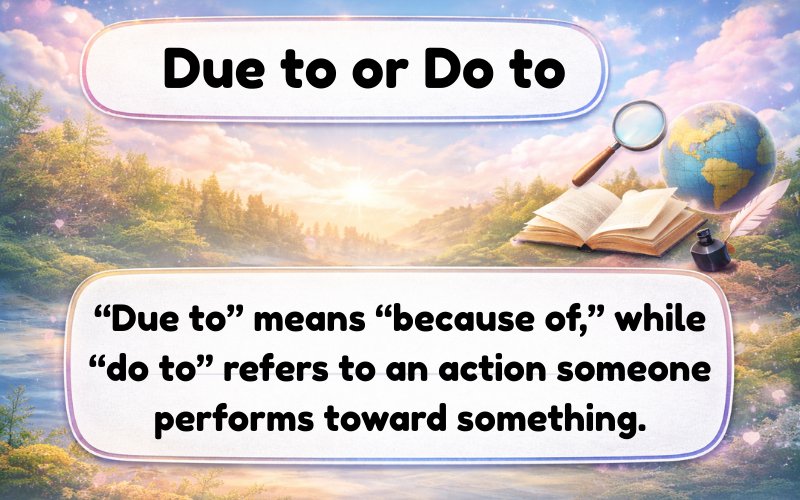
Although “due to” and “do to” sound identical in speech, their meanings are completely different. Due to is a phrase used to explain the cause or reason for something, while do to refers to an action someone performs toward something.
Understanding this distinction can greatly improve your writing and help you avoid common grammar mistakes. By remembering that due to explains a reason and do to describes an action, you can confidently choose the correct phrase in any situation.
