
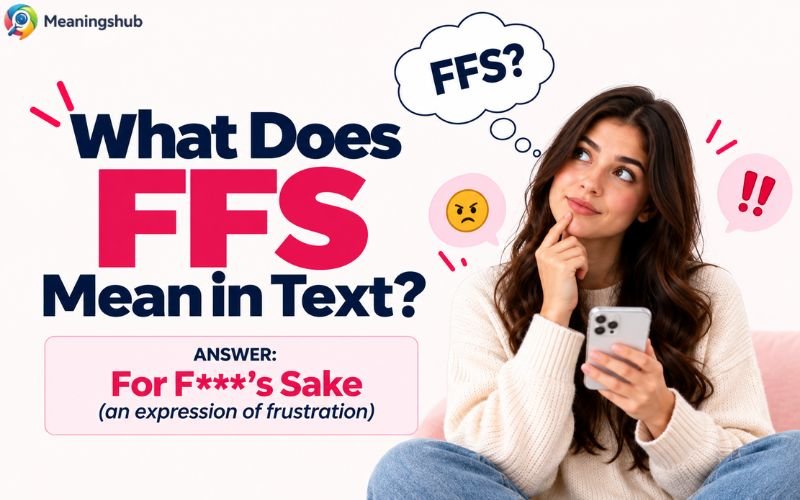
Have you ever seen someone text “FFS!” and wondered why they sounded so annoyed? The FFS meaning in text is usually “For F*’s Sake.”** It’s a strong informal expression people use when they’re frustrated, irritated, shocked, or fed up with something. It can be similar to saying “Seriously?” or “Come on!” but with much stronger language.
You’ll often see FFS in texts, social media comments, gaming chats, group messages, and online arguments. The meaning is usually easy to understand from the situation. If someone texts, “FFS, I forgot my keys again,” they’re clearly frustrated with themselves. If they write “FFS, stop doing that,” they’re irritated with someone else.
In this guide, we’ll look at what FFS stands for, how people use it today, what it means on Snapchat and TikTok, whether it can be playful, how it differs from WTF and OMG, and how to reply when someone sends it. We’ll also cover when FFS sounds too strong and why it’s usually better kept out of formal conversations.
FFS Meaning at a Glance
The most common FFS meaning is “For F*’s Sake.”** It is a profanity-based expression used to show strong frustration or exasperation.
| Term | Meaning | Tone | Common Use |
|---|---|---|---|
| FFS | For F***’s Sake | Frustrated, annoyed | Texts, chats |
| FFS! | Strong frustration | Angry or fed up | Social media |
| ffs | Same meaning | Casual | Group chats |
| FFS 😂 | Frustration mixed with humor | Playful | Friends, gaming |
The expression is usually stronger than simply saying “ugh,” “come on,” or “seriously.”
For example:
“FFS, I just spilled coffee on my shirt.”
The person isn’t necessarily angry at another person. They’re frustrated about what happened.
That’s an important part of understanding FFS: the target of the frustration isn’t always another person.
What Does FFS Mean in Text?
In texting, FFS usually means “For F*’s Sake.”**
It’s an exclamation people use when something has become frustrating, ridiculous, repetitive, or difficult to believe.
For example:
“FFS, why is my Wi-Fi down again?”
The person is annoyed because the same problem happened again.
Another example:
“FFS, I told you not to touch that.”
Here, the sender is clearly frustrated with another person.
The abbreviation is popular because it lets people express a strong emotion without typing the entire phrase.
Instead of:
“For f***’s sake, this is happening again!”
someone can simply write:
“FFS!”
The meaning is usually obvious to anyone familiar with internet slang.
What Does FFS Stand For?
FFS is made from the first letters of the words in the phrase:
F = For
F = F*
S = Sake
So:
FFS = For F*’s Sake**
The middle word is profanity, which is why the abbreviation is considered vulgar or strong informal language.
Some people use FFS so often that they don’t think much about the full phrase anymore. For them, it works almost like a reaction word.
It can communicate:
- Frustration
- Irritation
- Disbelief
- Impatience
- Exasperation
- Annoyance
The exact feeling depends on the situation.
Why Do People Say FFS?
People usually say FFS when something pushes their patience.
Maybe their computer crashes.
Maybe someone keeps repeating the same mistake.
Maybe they’ve explained something several times and the other person still doesn’t understand.
Maybe something ridiculous just happened.
For example:
“FFS, I missed the bus by ten seconds.”
The speaker is annoyed with the situation.
Another example:
“FFS, we’ve talked about this three times.”
This is directed at another person and sounds more confrontational.
The phrase gives the sentence extra emotional force.
Without FFS:
“I missed the bus.”
With FFS:
“FFS, I missed the bus.”
The second clearly shows frustration.
Related Post: YW Meaning in Text: What Does YW Mean in Texting?
Is FFS Always Angry?
No.
FFS usually signals frustration, but it doesn’t always mean serious anger.
Close friends sometimes use it jokingly.
For example:
“FFS 😂 you ate the whole pizza?”
The speaker may be teasing rather than genuinely angry.
Another example:
“FFS, I can’t believe how cute this dog is 😂”
Here, FFS is being used dramatically rather than aggressively.
This is where tone matters.
The same abbreviation can sound:
- Angry
- Funny
- Dramatic
- Playful
- Exasperated
Look at the words around FFS and any emojis that follow it.
FFS Meaning in Modern Texting
FFS fits naturally into casual online conversations because texting makes it easy to express strong reactions quickly.
You might see:
“ffs why did I do that”
“FFS 😭”
“FFS bro”
“Oh ffs.”
“FFS, seriously?”
The lowercase version doesn’t change the meaning.
Someone might type ffs because they normally write everything in lowercase. Another person might use FFS to make the reaction stand out.
Punctuation can also add intensity.
Compare:
“ffs.”
with:
“FFS!!!”
The second looks much more dramatic.
Still, people have different typing habits, so punctuation isn’t a perfect measure of emotion.
FFS Meaning on Snapchat
On Snapchat, FFS may appear in private chats, replies, or messages between friends.
For example:
“FFS 😂 you scared me!”
The sender may be annoyed but also joking.
Another example:
“ffs, my phone died.”
That’s a simple expression of frustration.
Snapchat is generally informal, so strong slang can appear naturally.
However, FFS contains profanity. If you’re talking to someone you don’t know well, you may want to choose a softer expression instead.
FFS Meaning on TikTok
TikTok comments can contain FFS when someone is reacting strongly to a video.
For example:
“FFS 😂 I wasn’t expecting that.”
This could mean the video was surprisingly funny.
Another comment might say:
“FFS, why would he do that?”
That sounds more frustrated or critical.
You’ll often see FFS alongside emojis because the emoji helps communicate the intended tone.
For example:
“FFS 😭”
could mean:
“I can’t deal with this.”
It doesn’t necessarily mean the commenter is seriously angry.
FFS Meaning on Instagram
On Instagram, FFS can appear in comments, DMs, captions, or story replies.
For example:
“FFS, this is beautiful.”
This could be dramatic praise rather than anger.
Or:
“FFS, stop posting spoilers!”
That is clearly frustration.
The platform doesn’t change the basic meaning. Instagram simply provides another place where people use casual internet language.
Related Post: LFG Meaning Slang: What It Means and Why Everyone Says It
FFS Meaning in Gaming
FFS is particularly useful in gaming chats because games can create a lot of frustration very quickly.
A player might type:
“FFS, I missed the shot!”
They’re frustrated with their own mistake.
Another player might say:
“FFS, he’s camping again.”
Here, the frustration is directed toward another player’s behavior.
Or:
“FFS 😂 that was the funniest glitch.”
This version is more playful.
Gaming communities often use FFS alongside terms such as GG, WTF, LMAO, and bro.
FFS Meaning in Gen Z Conversations
FFS isn’t a term invented by Gen Z, but younger internet users still use it in casual conversations.
It works well with modern texting habits because it’s short and emotionally strong.
A conversation might look like:
“Did you see what he posted?”
“FFS 😭 yes.”
Or:
“I forgot my charger again.”
“ffs 💀”
The abbreviation can be used seriously or jokingly.
Gen Z and other internet users also commonly combine FFS with emojis to make the intended mood clearer.
For example, FFS 😂 sounds different from FFS 😡, even though the letters are identical.
FFS Meaning From a Girl
If a girl sends you “FFS,” the abbreviation itself doesn’t tell you exactly why she’s frustrated.
For example:
“FFS, you forgot again.”
sounds genuinely annoyed.
But:
“FFS 😂 you’re so dramatic.”
could be playful teasing.
If she sends:
“FFS 😭 I can’t believe that happened.”
she may simply be reacting dramatically to an embarrassing or funny situation.
The safest way to understand it is to read the complete message.
Don’t assume FFS automatically means she’s angry with you.
FFS Meaning From a Guy
The same applies when a guy uses FFS.
For example:
“FFS bro, what are you doing?”
sounds frustrated.
But:
“FFS 😂 look at this.”
may simply mean something is funny or ridiculous.
The abbreviation doesn’t have a special male meaning.
The surrounding words, punctuation, emojis, and situation tell you much more.
FFS vs WTF
FFS and WTF are both strong expressions, but they usually serve slightly different purposes.
FFS focuses more on frustration or exasperation.
WTF often focuses on shock, confusion, or disbelief.
| Expression | Meaning | Common Feeling |
|---|---|---|
| FFS | For F***’s Sake | Frustration |
| WTF | What the F*** | Shock or confusion |
| OMG | Oh My God | Surprise or excitement |
| SMH | Shaking My Head | Disappointment |
| UGH | Expression of annoyance | Frustration |
For example:
“FFS, I forgot my password again.”
The main emotion is frustration.
But:
“WTF is happening?”
sounds more confused or shocked.
There can be overlap, but FFS usually has a stronger feeling of “I’m really fed up with this.”
FFS vs OMG
OMG usually means “Oh My God.”
It’s much more flexible and doesn’t necessarily involve frustration.
For example:
“OMG, your new car looks amazing!”
is positive.
But:
“FFS, your car is blocking the driveway.”
is clearly annoyed.
OMG can express excitement, surprise, happiness, or shock.
FFS usually carries more irritation.
FFS vs SMH
SMH means “Shaking My Head.”
It’s commonly used to show disappointment, disbelief, or annoyance.
For example:
“He forgot his own birthday. SMH.”
FFS is stronger:
“FFS, how did he forget his own birthday?”
SMH can sound disappointed or judgmental without profanity.
FFS is more emotional and direct.
Related Post: FWB Meaning in Text: What Does FWB Mean in Texting?
FFS vs LOL
These two are very different.
LOL means “Laughing Out Loud.”
FFS expresses frustration or exasperation.
However, people can combine them:
“FFS LOL, you really did that?”
This can mean:
“I can’t believe you did that, but it’s also hilarious.”
Internet slang often overlaps like this, especially between friends.
How to Reply to “FFS”
Your response depends on why the person said it.
If they’re clearly frustrated with you, it may be better to stay calm:
“Sorry, I didn’t mean to.”
If they’re joking:
“😂 I know!”
If they’re frustrated about a situation:
“Yeah, that’s annoying.”
If you aren’t sure what they mean:
“What happened?”
You don’t need to respond to the profanity itself.
Respond to the actual problem or emotion behind the message.
What Does “FFS 😭” Mean?
This combination is common in casual online conversations.
The 😭 emoji doesn’t necessarily mean sadness. It can represent laughter, embarrassment, frustration, or feeling overwhelmed.
So:
“FFS 😭”
could mean:
“I can’t deal with this.”
or:
“This is so ridiculous.”
or:
“I can’t believe this happened.”
The exact meaning depends on what came before it.
For example:
“I just sent the message to the wrong person.”
“FFS 😭”
That’s probably embarrassment and frustration.
What Does “FFS 😂” Mean?
When FFS is followed by 😂, the tone is often more playful.
For example:
“FFS 😂 you actually wore that?”
The person may be teasing.
Another example:
“FFS 😂 I can’t stop laughing.”
Here, FFS is being used for dramatic emphasis.
The profanity remains part of the expression, but the overall message doesn’t necessarily sound hostile.
What Does “FFS Bro” Mean?
“FFS bro” usually means the person is frustrated, surprised, or playfully annoyed with a friend.
For example:
“FFS bro, you missed the easiest shot.”
This is likely frustration in a gaming situation.
But between close friends:
“FFS bro 😂”
could simply be playful teasing.
Again, the relationship matters.
Related Post: OML Meaning in Text: What Does OML Mean in Texting?
Can FFS Be Used Positively?
Yes, although this is less obvious.
People sometimes use FFS for dramatic emphasis, even when they’re not genuinely angry.
For example:
“FFS, this pizza is good.”
The person may be exaggerating for humor.
Or:
“FFS, you’re actually talented.”
This could be enthusiastic praise.
The expression still has a slightly rough tone because of the profanity, but the emotional direction can be positive.
Is FFS Rude?
FFS can be considered rude or offensive because it contains profanity.
How rude it feels depends on the audience and situation.
Between close friends, it may be completely normal.
In a workplace, school setting, customer service conversation, or formal message, it may come across as inappropriate.
For example:
“FFS, fix this.”
would sound aggressive in a professional email.
A softer version would be:
“Could you please fix this?”
Knowing your audience is important when using strong slang.
Is FFS Formal or Informal?
FFS is very informal.
It is best kept for casual conversations with people who are comfortable with profanity.
You may see it in:
- Text messages
- Group chats
- Gaming
- TikTok comments
- Instagram DMs
- Snapchat
- Reddit discussions
- Casual social media posts
It’s generally not suitable for:
- Job applications
- Business emails
- Academic writing
- Professional reports
- Official complaints
- Formal customer communication
If you’re unsure, use a less offensive phrase such as “seriously,” “come on,” “ugh,” or “this is frustrating.”
Is FFS Still Used?
Yes. FFS remains recognizable and commonly used in informal online communication.
It’s been around for years and continues to appear in texting, gaming, social media, and online communities.
It isn’t specifically Gen Z slang. Different generations may use it, especially people who regularly communicate online.
The way it appears can change:
FFS
ffs
ffs 😭
FFS bro
Oh ffs.
But the basic meaning remains connected to frustration or strong exasperation.
Common Ways People Write FFS
The abbreviation can appear in several forms.
FFS
The standard uppercase version:
“FFS, not again.”
ffs
The casual lowercase version:
“ffs why does this keep happening”
Oh FFS
A slightly more conversational version:
“Oh ffs, I forgot my wallet.”
FFS!
An especially strong reaction:
“FFS! Stop doing that!”
FFS 😂
A playful or humorous version:
“FFS 😂 you’re impossible.”
The writing style can affect the tone, but context remains more important.
Related Slang Terms
If you’re learning FFS, these expressions are worth knowing too.
| Slang | Meaning | Typical Use |
|---|---|---|
| WTF | What the F*** | Shock or confusion |
| SMH | Shaking My Head | Disappointment |
| OMG | Oh My God | Surprise or excitement |
| UGH | Annoyed reaction | Frustration |
| LMAO | Laughing My Ass Off | Strong laughter |
These terms can overlap, but they aren’t interchangeable.
For example, SMH often sounds more disappointed, while FFS sounds more frustrated.
Related Post: TS Boys Meaning in Text: What Does “TS Boys” Mean?
Real-Life Examples of FFS
Example 1: Frustrated With Yourself
“FFS, I left my phone at home again.”
The person is annoyed at their own mistake.
Example 2: Frustrated With Someone Else
“FFS, I already told you the answer.”
The speaker is clearly getting impatient.
Example 3: Playful Reaction
“FFS 😂 you actually bought another pair of shoes?”
The person may be teasing rather than genuinely angry.
These examples show why context matters when interpreting FFS.
Example Sentences With FFS
| Situation | Example | What It Means |
|---|---|---|
| Mistake | “FFS, I forgot my keys.” | Frustration |
| Repeated problem | “FFS, the Wi-Fi is down again.” | Annoyance |
| Gaming | “FFS, I missed the shot.” | Frustration |
| Teasing | “FFS 😂 you did that again?” | Playful annoyance |
| Disbelief | “FFS, seriously?” | Strong disbelief |
When Should You Use FFS?
FFS works best when:
- You’re talking casually.
- The people involved are comfortable with profanity.
- You want to express strong frustration.
- The situation isn’t formal.
- The tone won’t be misunderstood.
Before using it, think about who you’re talking to.
FFS may be completely normal between close friends but inappropriate when speaking with a manager, teacher, customer, or someone you’ve just met.
If you’re unsure, choose a softer phrase.
What Are Softer Alternatives to FFS?
If you want the same general feeling without profanity, you have several options.
You could say:
- “Seriously?”
- “Come on!”
- “Ugh.”
- “Oh, come on.”
- “For goodness’ sake.”
- “I can’t believe this.”
- “This is so frustrating.”
These alternatives are useful when you’re annoyed but don’t want your message to sound aggressive.
For example:
“FFS, not again!”
could become:
“Oh, come on, not again!”
The emotion remains, but the language is softer.
See Also: FJB Meaning in Text: What Does FJB Mean?
Frequently Asked Questions
What does FFS mean in text?
FFS usually means “For F***’s Sake,” a strong informal expression of frustration, annoyance, disbelief, or exasperation.
What does FFS mean on Snapchat?
On Snapchat, FFS usually shows frustration or playful annoyance, depending on the message and emojis surrounding it.
Is FFS a bad word?
FFS contains profanity, so it’s considered vulgar and should generally be avoided in formal or professional communication.
Can FFS be used jokingly?
Yes, friends sometimes use FFS jokingly to exaggerate frustration, especially when paired with laughing or crying emojis.
How should I reply to FFS?
Respond to the situation behind it; acknowledge the frustration, explain yourself, apologize, or ask what happened.
Is FFS still used?
Yes, FFS remains common in casual texts, gaming chats, social media comments, and other informal online conversations.
Quick Recap
The most common FFS meaning in text is “For F*’s Sake.”** It’s a strong, informal expression used when someone is frustrated, impatient, annoyed, or fed up.
You’ll see it in texts, Snapchat, TikTok, Instagram, gaming chats, and group messages. It can be serious, but friends also use it playfully.
For example:
“FFS, I forgot my keys again.”
means the person is frustrated with their mistake.
Meanwhile:
“FFS 😂 you actually did that?”
may simply be playful teasing.
Because FFS contains profanity, it’s best suited to casual conversations. If you’re writing to a boss, teacher, customer, or professional contact, choose a softer phrase such as “seriously,” “come on,” or “that’s frustrating.”
The easiest way to understand FFS is to look at the context. The three letters usually signal strong frustration, but the surrounding words, emojis, and relationship between the people can turn that frustration into humor, disbelief, or playful teasing.
