
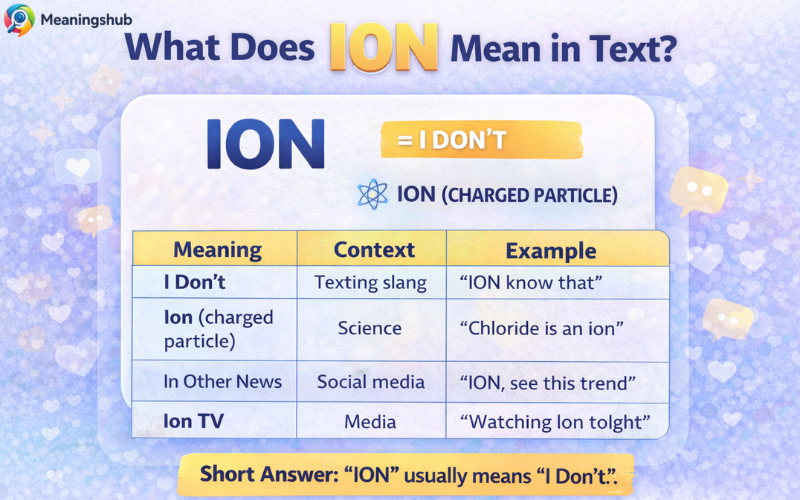
If you have seen “ION” in a text message, comment, or social media post, you may wonder what it means. In casual online conversations, ION usually means “I don’t.” It is a shortened form that people use to type faster and make their messages sound more relaxed. For example, someone might write, “ION know what you mean,” which means, “I don’t know what you mean.” This form is common in informal texting and social media conversations.
ION is often used before a verb or phrase that normally follows “I don’t.” You may see it in messages such as “ION want to go” or “ION think so.” The meaning is usually easy to understand when you read the whole sentence.
It is important to remember that ION is informal. It is not normally used in school assignments, professional emails, or other formal writing. Some people may also use ION differently depending on their online community, so context is always helpful.
Learning common texting terms like ION can make online conversations easier to understand. Once you know that ION often means “I don’t,” you can quickly understand its meaning from the rest of the message.
One-line answer:
“ION” in text usually means “I Don’t,” but it can also refer to an “Ion” in science depending on the context.
What Does ION Mean in Text?
“ION” is a commonly used slang abbreviation in texting and online communication. Its primary meaning is “I Don’t.” It is often used to replace phrases and make typing faster. However, it can also have other meanings depending on the situation, including scientific usage.
Related Post: HWY Meaning: Means in Text And Social Media
Quick Overview Table of ION Meanings
| Meaning | Context | Usage Type | Example |
|---|---|---|---|
| I Don’t | Texting/slang | Informal | “ION know what you mean” |
| Ion (charged particle) | Science | Formal | “An ion carries a charge” |
| In Other News | Social media | Informal | “ION, did you see that?” |
| Ion TV | Media | Neutral | “I watch shows on Ion” |
ION as “I Don’t”
The most common meaning of “ION” in texting is “I Don’t.” It is used to shorten everyday phrases and make communication quicker.
Examples:
- “ION know what you mean.”
- “ION care about that.”
- “ION think that’s right.”
- “ION wanna go out today.”
How “I Don’t” Works in Context
“ION” can be used in different conversational situations:
- Expressing uncertainty: “ION know.”
- Showing disinterest: “ION care.”
- Refusing something: “ION wanna do that.”
- Giving an opinion: “ION think it’s good.”
ION in Social Media and Internet Culture
“ION” is widely used on platforms like TikTok, Instagram, Snapchat, and Twitter (X). It is especially popular among younger audiences because it simplifies typing and keeps conversations casual.ION as a Scientific Term
In science, “ion” refers to a charged particle formed when an atom gains or loses electrons.
Examples:
- “Sodium forms a positive ion.”
- “Chloride becomes a negative ion.”
Other Possible Meanings of ION
Although less common, “ION” can also mean:
- In Other News: Used to shift topics
- Ion Television: A TV network reference
Context Comparison Table
| Situation | Meaning of ION | Example Sentence | Tone |
|---|---|---|---|
| Casual texting | I Don’t | “ION feel like going out” | Relaxed |
| Social media | In Other News | “ION, look at this update” | Informal |
| Academic/science | Charged particle | “An ion has an electric charge” | Formal |
| Entertainment/media | Ion TV | “Watching Ion tonight” | Neutral |
How to Identify the Correct Meaning of ION
- Look at the sentence structure
- Check the tone of conversation
- Consider the platform or environment
Why People Use ION
- Saves time while typing
- Fits casual communication
- Makes conversations quicker
- Widely recognized in slang
Related Post: What Does ML Mean
Examples of ION in Real Conversations
Casual Chat:
- “ION feel like going out.”
Group Chat: - “ION know what’s happening.”
Social Media: - “ION think this trend is good.”
Academic Context: - “An ion carries a charge.”
Tone Variations of ION
- ION → Neutral
- ion → Casual
- ION!!! → Emphasized
- ion 😂 → Light tone
- ION… → Hesitation
ION vs Similar Abbreviations
- ION vs IDK: ION is broader, IDK is specific
- ION vs IDC: ION is flexible, IDC shows indifference
- ION vs full phrase: Same meaning, shorter form
When Should You Use ION?
Use ION when:
- Texting casually
- Chatting on social media
- Talking with friends
Avoid ION when: - Writing emails
- Professional communication
- Academic writing (except science)
Advantages and Disadvantages of Using ION
Advantages:
- Saves time: ION is quicker to type than “I don’t.”
- Easy for casual chats: It fits naturally in friendly text messages and social media posts.
- Shows an informal style: It can make a message sound relaxed and casual.
- Common in online slang: People familiar with texting language can understand it easily.
Disadvantages:
- May confuse some people: Not everyone knows that ION means “I don’t.”
- Not suitable for formal writing: It should generally be avoided in school, work, and official writing.
- Can be misunderstood: ION has other meanings in different subjects, so context matters.
- Depends on the audience: Older people or people unfamiliar with internet slang may not understand it quickly.
Tips for Using ION Effectively
- Use clear context
- Know your audience
- Avoid overuse
- Switch to full phrases when needed
Alternatives to ION
- I don’t
- I don’t know
- I don’t care
- I don’t think
See Also: HMB Meaning in Text: What It Means And How to Use It
The Role of ION in Digital Communication
“ION” highlights how communication is evolving toward speed, simplicity, and convenience. It allows users to express ideas quickly without long sentences.
ION in Social Media Culture
“ION” is commonly used on:
- TikTok
- Snapchat
- Twitter (X)
Psychological Impact of Using ION
Using “ION” can:
- Make conversations feel relaxed
- Reduce effort
- Show casual tone
But overuse can reduce clarity and seriousness.
Common Mistakes When Using ION
- Using it in formal contexts
- Misinterpreting meaning
- Overusing slang
The Future of ION
The future use of ION will likely depend on how texting and social media language continue to change. Short forms are popular because they make online conversations faster and more casual. As new slang develops, ION may remain common in some online communities, while other users may prefer newer abbreviations. Its use will mostly stay connected to informal communication.
The Evolution of ION
ION became popular as people started shortening common phrases in digital conversations. Instead of typing “I don’t,” some users began writing “ION” as a quick alternative. Social media, texting apps, and online communities helped spread this style of communication.
Over time, ION became easier to recognize in casual messages. However, its meaning can still depend on context. In everyday texting, it usually means “I don’t,” while in science or other subjects, ION can have completely different meanings.
See Also: What Does SP Mean? Complete Guide to Meanings in Text
FAQs
What does ION mean in text?
In texting and online chats, ION usually means “I don’t.” It is an informal shortened form used to make messages quicker to type.
What is an example of ION in a text?
An example is “ION know what happened.” It means “I don’t know what happened.”
Is ION a texting slang word?
Yes. ION is commonly used as informal texting slang, especially in social media posts, comments, and casual conversations.
Is ION the same as “I don’t”?
In many casual messages, yes. ION is often used as a shorter way to write “I don’t.”
Can I use ION in formal writing?
It is better to avoid ION in formal writing. Use “I don’t” in school assignments, professional emails, and official documents.
Why do people use ION in messages?
People use ION mainly because it is short and quick to type. It also gives messages a casual and natural online style.
Does ION have other meanings?
ION can have other meanings in different subjects, especially science and technology. However, in casual texting, it commonly means “I don’t.”
How can I understand ION correctly?
Look at the full sentence and context. The words after ION usually make its intended meaning clear.
Conclusion
“ION” is a versatile abbreviation that most commonly means “I Don’t” in texting but can also have other meanings depending on context. Its flexibility makes it useful in casual communication, but it should be used carefully to avoid confusion. Understanding how and when to use “ION” will help you communicate more effectively in modern digital conversations.
