
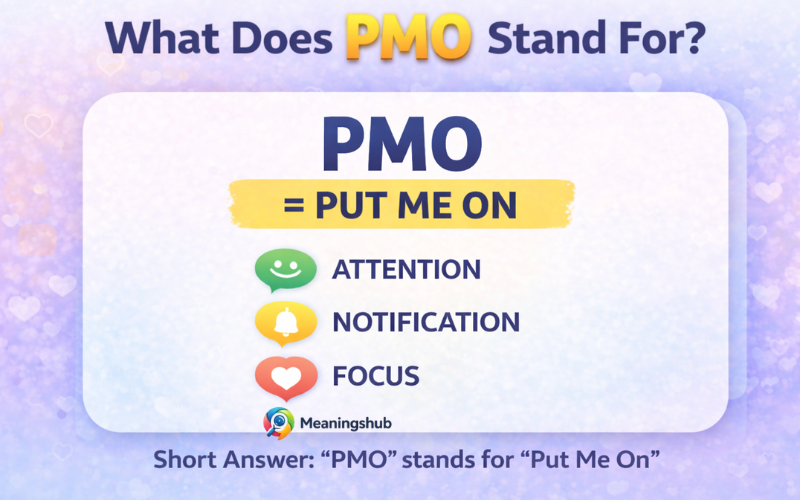
If you have seen “PMO” in a text message or online chat, you may wonder what it means. PMO can have different meanings, so the right meaning depends on the conversation. In modern texting and social media, PMO often means “piss me off,” which is used when someone or something makes a person angry or annoyed. For example, “That noise really PMO” means “That noise really pisses me off.” Because this meaning includes strong language, it is usually used in casual conversations.
PMO can also mean “put me on,” especially in online conversations. In this use, someone is asking another person to introduce them to something new or give them more information. For example, “PMO some good songs” can mean “Put me on to some good songs.” This use is common when talking about music, movies, games, clothes, or other interests.
The words around PMO can help you understand which meaning the writer intended. If the message sounds angry, it may mean “piss me off.” If someone is asking for recommendations or information, it may mean “put me on.” Knowing the context is the best way to understand PMO meaning in text correctly.
One-line answer:
“PMO” in text commonly means “Put Me On,” used to ask someone to share information, recommend something, or introduce you to something new.
What Does PMO Mean in Text?
“PMO” is a widely used slang abbreviation in texting and online communication. Its most common meaning is “Put Me On,” which is used when someone wants to be introduced to something, learn about something new, or get recommendations. However, like many internet slang terms, “PMO” can also have other meanings depending on the situation. Understanding the context is essential to interpreting it correctly.
PMO as “Put Me On”
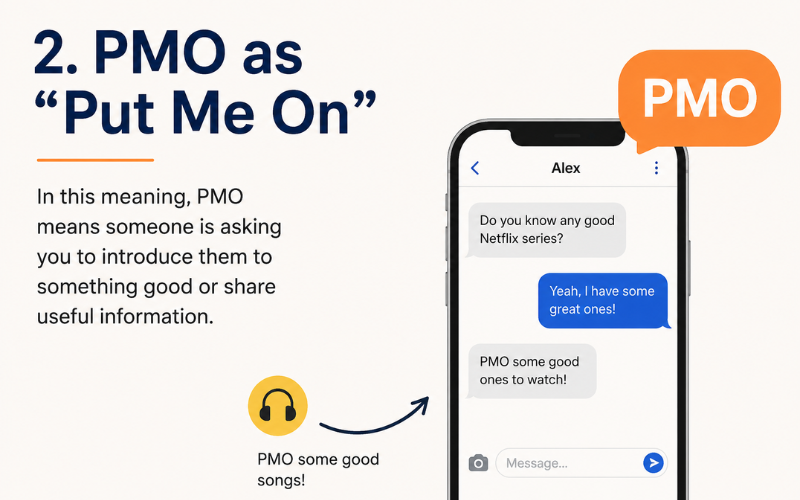
The most popular meaning of “PMO” is “Put Me On.” It is commonly used when someone is asking for suggestions, recommendations, or information. It can also mean introducing someone to a person, trend, or opportunity.
Examples:
- “That song is fire, PMO to more like this.”
- “PMO some good movies to watch.”
- “You know any good restaurants? PMO.”
- “PMO to that brand, it looks cool.”
In these examples, “PMO” is a request for help or guidance.
How “Put Me On” Works in Context
The phrase “Put Me On” can be used in different ways depending on the situation.
- Asking for recommendations: “PMO some good shows.”
- Asking to be introduced: “PMO to your friend.”
- Asking for knowledge: “PMO on how this works.”
- Asking for opportunities: “PMO if there’s any job opening.”
This flexibility makes “PMO” a highly useful and popular abbreviation.
Other Meanings of PMO
Although “Put Me On” is the most common meaning, “PMO” can also have other interpretations.
- Piss Me Off: Used to express frustration
- “That situation really PMO.”
- Project Management Office: Used in business contexts
- “The PMO handles project coordination.”
- Private Message Only: Used in online platforms
- “Contact me PMO.”
The meaning depends entirely on the context and tone of the conversation.
- “Contact me PMO.”
Related Post: What Does TBH Stand For
How to Identify the Correct Meaning of PMO
Since “PMO” has multiple meanings, you need to rely on context.
- Look at the sentence: “PMO some songs” vs “That really PMO”
- Analyze tone: Positive/request → “Put Me On,” Negative → “Piss Me Off”
- Consider platform: Casual chat → slang, Work → formal meaning
Why People Use PMO
There are several reasons why “PMO” is widely used:
- Saves time when typing
- Fits casual communication styles
- Allows quick requests for recommendations
- Widely used in youth and social media culture
Examples of PMO in Real Conversations
Casual Chat:
- “I need new music, PMO.”
Social Media: - “This place looks amazing, PMO.”
Group Chat: - “PMO some good games to play.”
Negative Context: - “That really PMO.”
Tone Variations of PMO
The tone of “PMO” can change depending on how it is written.
- PMO → Neutral
- pmo → Casual
- PMO!!! → Strong emphasis
- PMO 😂 → Lighthearted
- PMO… → Hesitant or emotional
PMO vs Similar Slang
- PMO vs “LMK” (Let Me Know):
- PMO → Asking for suggestions
- LMK → Asking for information
- PMO vs “Put Me On Game”:
- Similar meaning
- PMO is shorter
- PMO vs “Suggest”:
- Suggest → Formal
- PMO → Informal
When Should You Use PMO?
Use PMO when:
- Texting friends
- Asking for recommendations
- Chatting on social media
Avoid PMO when: - Writing professional emails
- Communicating formally
- Academic writing
See Also: TS Boys Meaning in Text: What Does “TS Boys” Mean?(2026)
Advantages of Using PMO
- ✔ Quick and efficient
- ✔ Versatile meaning
- ✔ Fits modern slang
- ✔ Encourages interaction
Disadvantages of Using PMO
- ✖ Can be confusing
- ✖ Not suitable for formal use
- ✖ Multiple meanings may cause misunderstanding
Tips for Using PMO Effectively
Using PMO correctly is mostly about understanding the context and knowing your audience. Here are some simple tips:
- Know the meaning: Check whether PMO means “Put Me On” or “piss me off” before using it.
- Use clear context: Add enough words around PMO so the reader can understand your meaning.
- Know your audience: Use PMO with friends or people who understand texting slang.
- Avoid formal writing: Do not use PMO in professional emails, school assignments, or official messages.
- Consider the tone: If PMO means “piss me off,” remember that it can sound strong or rude.
- Use it naturally: Do not add PMO to every message. Use it only when it fits the conversation.
- Write it out when needed: If you think the reader may be confused, use the full phrase instead.
Alternatives to PMO
For “Put Me On”:
- Recommend me
- Suggest
- Let me know
- Introduce me
For “Piss Me Off”: - Annoy
- Frustrate
The Role of PMO in Digital Communication
“PMO” reflects modern communication trends such as:
- Speed
- Simplicity
- Informality
It allows users to quickly ask for suggestions or express emotions.
PMO in Social Media Culture
“PMO” is widely used on platforms like:
- TikTok
- Snapchat
- Twitter (X)
It is especially popular among younger audiences.
Psychological Impact of Using PMO
Using “PMO” can:
- Encourage engagement
- Show curiosity
- Build connections
However, misuse can: - Cause confusion
- Lead to misinterpretation
Common Mistakes When Using PMO
One common mistake when using PMO is assuming that it always has the same meaning. PMO can mean “Put Me On” or “piss me off,” so the context is important.
Another mistake is using PMO in formal situations. It is mainly an informal texting abbreviation and may not be suitable for school assignments, professional emails, or official messages.
People can also misunderstand PMO when the message does not give enough context. For example, “PMO this song” may be unclear to someone who does not know the slang.
To avoid confusion, use PMO only when the other person is familiar with texting slang. If there is a chance of misunderstanding, writing the full phrase is a better choice.
The Evolution of PMO
The use of PMO has changed with the growth of texting, social media, and online conversations. People often use short forms like PMO because they make messages faster and easier to type. Over time, PMO has developed more than one common meaning.
One popular meaning is “Put Me On.” People use it when asking someone to recommend or introduce them to something new, such as music, movies, games, food, or fashion. For example, “PMO some good songs” means “Recommend some good songs to me.”
PMO can also mean “piss me off,” especially when someone is talking about something that made them angry or annoyed. Because PMO has different meanings, the surrounding words are important.
Today, PMO is mostly used in casual texting, comments, and social media. Its meaning depends on the topic and tone of the conversation..
The Future of PMO
“PMO” is likely to remain popular due to its usefulness in quick communication, although its meaning may evolve over time.
See Also: FJB Meaning in Text: What Does FJB Mean in a Text Message?
FAQs
What does PMO mean in text?
PMO can have different meanings in texting. It often means “piss me off” or “put me on.” The context helps you know which meaning is intended.
What does PMO mean as “Put Me On”?
When PMO means “Put Me On,” it usually means asking someone to recommend or introduce you to something. For example, “PMO some good music” means “Recommend some good music to me.”
How do you use PMO in a sentence?
You can say, “PMO some good movies to watch.” This means you are asking someone to recommend some good movies.
Is PMO slang?
Yes. PMO is commonly used as internet slang or a texting abbreviation in casual conversations, especially on social media and messaging apps.
Does PMO always mean “Put Me On”?
No. PMO does not always have the same meaning. It can also mean “piss me off.” Reading the full message is important before deciding what it means.
Is PMO formal or informal?
PMO is informal and is mainly used in texting, online chats, comments, and social media. It is better to avoid it in formal school or work writing.
Conclusion
“PMO” is a versatile abbreviation that most commonly means “Put Me On,” used to ask for recommendations, introductions, or information in texting and social media. It can also have other meanings depending on context, making it important to understand how it is used in a conversation. While it is highly effective in casual communication, it should be used carefully to avoid confusion and should be avoided in formal settings. By understanding context, tone, and audience, you can use “PMO” effectively and confidently in modern digital communication.
